
Garima GurungMay 13, 2026
UGC Pricing in 2026: How Much Does Creators Make?
.png&w=3840&q=75)
User-generated content has rapidly become one of the most effective marketing tools for brands. Not because it is neither new nor entirely artistic.
But because it tends to work, and often in ways we may not fully understand. However, this has definitely created a rift. Brands want performance. Creators want clarity. And in between, there lies a question everybody is wondering:
TL;DR
- UGC creators typically charge $150–$300/video. Rates vary by experience, platform, usage rights, and content type.
- Bundles of 5+ videos get 15–25% discounts. Usage rights add 30–50% to the base rate.
How much should UGC actually cost?
In 2026, that question is almost always answered through a single metric: Customer Acquisition Cost (CAC). It has become the definitive bridge between creativity and finance and understanding it will change how you think about UGC entirely.
What is Customer Acquisition Cost(CAC) and Why Does it Define UGC Value?
On the surface, CAC is simple:
CAC = Total Sales & Marketing Spend ÷ Total New Customers Acquired
But that simplicity is deceptive. What brands are doing now is looking far beyond vanity metrics "likes," "views," or follower counts and asking one sharper question: did this content acquire customers, and at what cost?
CAC has become the primary lens through which UGC campaigns are evaluated. That calculation factors in paid media spend and creative performance: hooks, storytelling, pacing, and iteration. The catch? Most brands severely underestimate how much UGC contributes to acquisition. And most creators underestimate their own role in it.
When you pair a massive ad budget with weak creative, you don't just lose money ,you actively inflate your CAC. Bad content makes platform algorithms grumpy. Lower engagement signals drive up CPMs, meaning you pay more to reach the same people. The algorithm always notices.
Why UGC Impacts CAC
On paper, CAC is effortless. Just total sales and marketing costs by the total number of new customers, and you get your CAC.
That’s it. Almost comforting in its own simplicity.
In reality, however, it's shaped by a mix of buying decisions, platform behavior, seasonality, and most importantly, creativity. Creativity is what people underestimate most because it is where UGC becomes more important than it appears.
Think The Walking Dead, everyone’s going through an apocalypse and has access to almost the same tools, yet some people build safe zones, while others…..don’t even last an episode. The gap here is creativity, which is why UGC punches above its weight.
Now, let’s make it more practical.
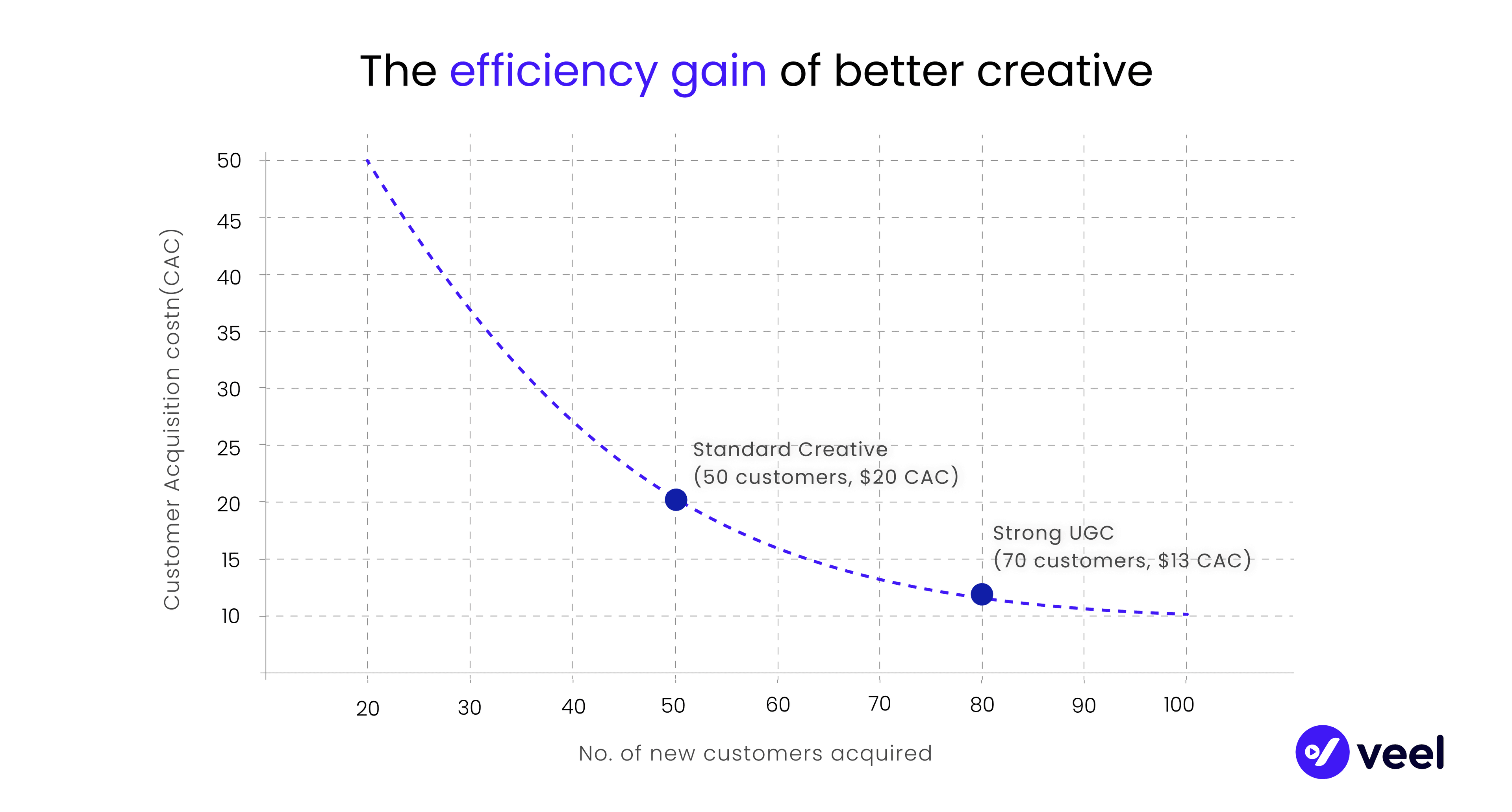
A brand spends $1,000 on ads and acquires 50 new customers. Using the formula, the CAC is $20. Nothing unusual here.
Now, replace the same creative with a strong UGC. With the same product, offer, budget, and audience, the same content brings 70 new customers, and CAC drops to $14.
The only real difference is that this content actually held attention and communicated value in a way that felt local to the platform.
If you want to see what that looks like in practice, check out Inspired by Veel for real examples of UGC content that's driven measurable results for brands.
UGC Creator Rates in 2026: How Much Does UGC Cost?
So what does this mean for creators? From a brand’s perspective, the math is clear. From a creator’s perspective, it's a bit more complicated. It’s 2026 now, everyone! The tiers have shifted away from follower counts and are leaning more towards performance intuition. But remember, what you actually pay or charge depends on experience level, platform, deliverables, and usage rights.
ugc content creator rates:
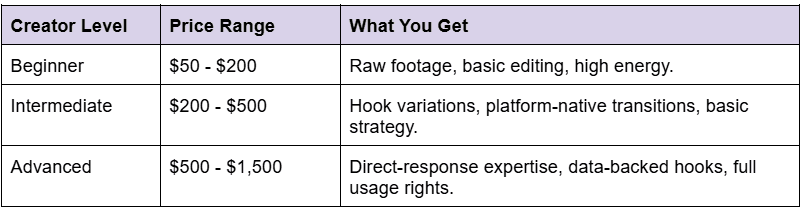
Two creators with the same rate can give you completely different results. Creator A gives you aesthetically pleasing content, but zero sales. Creator B can give you something that converts. The difference comes from understanding the audience psychology, platform rhythm, and what actually makes someone stop scrolling.
Some advanced UGC creators also distribute content on their own social channels, allowing brands to benefit from both paid advertisements and creator led reach. It’s like a “cultivated whole brain” moment where they understand both content creation and the way it performs across different environments without needing constant monitoring. It's a dual channel advantage that the best creator campaigns are increasingly built around.
Want to see how Veel's plans are structured for brands at different stages? View Veel's pricing here.
How Much Does a UGC Campaign Cost?
UGC campaign costs vary depending on the number of creators, campaign type, and content volume. Traditional agencies often charge thousands of dollars per month, while many UGC platforms charge per video or require long-term contracts.
With Veel, brands can launch creator campaigns starting at $150/month, with access to creators, campaign management, AI-powered campaign tools, content approvals, analytics, and creator payouts included in a single platform.

UGC vs Influencer Marketing
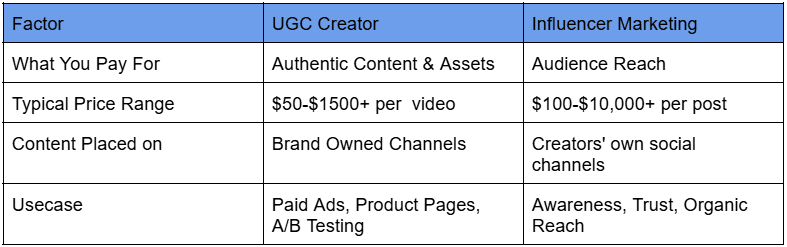
UGC and influencer marketing are often grouped, but they operate on completely different value propositions.
When you hire a UGC creator, you are paying for a content asset you own and can deploy repeatedly across all social media channels.
Influencers, on the other hand, have larger followings than UGC creators. This means that you are paying to promote the content to their audience. It mainly focuses on value, reach, trust, and the ability to drive engagements or sales. So, the higher the number of followers, the higher the price tag.
That’s why the pricing looks so different:
UGC video: $50 - $500/ video (sometimes higher with experience and licensing)
Influencer post: $100 - $10,000 (depending on the audience size)
Not sure which is the right fit for your next campaign? Veel supports both : explore the creator campaigns platform to see how brands structure each approach.
For a broader look at how Veel compares to other platforms on the market, the UGC platform comparison for 2026 breaks it down in detail.
Why Hooks Matter
This hook isn’t for fishing (important clarification for 2026 audience). It’s the 1.5 seconds you have before a user’s thumb determines whether your content is up for a game. It determines your video retention rate, which directly influences platform algorithm favour, cost per thousand impressions (CPM), and click-through rate.
It’s almost like the most expensive part of the video, because it determines whether viewers leave or stay. If a 30-second video has a hook that loses 80% of viewers in the first 3 seconds, you have effectively produced a 3-second ad and wasted 27 seconds of production value.
Why?
For example, you have two videos that are the same, just the first few seconds are different. One video gets little to no engagement, and the other video has people actively engaged.
What’s more is that it’s like you never get a second chance to make the first impression, because the first few seconds of a video determine the performance of the same video body; whether people want to keep watching or scroll away.
How does UGC lower your CAC?
This is where things get slightly ironic. Cheap content feels efficient in the beginning, like looking at the lower cost, lower risk, a line that makes the procurement department purrr. It sounds reasonable upfront until you hit the publish button.
Brands like Gym shark play a solid role in this, focusing more on community led UGC to scale the acquisition. They didn’t build an empire on polished, glory commercials, but around ‘everyday’ people.
A sweaty post workout selfie? Posted. A video of someone struggling through a PR in Gym shark gear? Posted.
This wasn’t just content, but a decentralized trust system. When your customers are your creators, something powerful happens to your CAC over time. By the time a new potential customer reaches your product page, they have often already encountered 10, 20, or 30 real people wearing your product organically. The trust barrier is dramatically lower. The conversion is faster. The CAC falls. That's the long game of UGC creator marketing. And it's why brands that treat UGC as a performance channel rather than a content checkbox are the ones consistently winning on CAC.
The Bottom Line
In 2026, UGC isn't a content strategy : it's a customer acquisition strategy. As ad costs climb, the brands that win are the ones who invest in creators who can hold attention, build trust, and convert.
The value of UGC isn't measured by how polished it looks. It's measured by how effectively it lowers CAC and turns viewers into customers.
And if you're still exploring, the Veel blog has guides on everything from building long-term influencer partnerships to why brands hire UGC creators in 2026.
Ready to start building high performing UGC