
Jeevan PokharelJune 30, 2026
UGC Creators Vs Influencers: What's the Difference
If you've been trying to figure out the difference between a UGC creator and an influencer, you're not alone. The terms get used interchangeably all the time and that confusion is costing brands real money.
Here's the short version: a UGC creator sells you content. An influencer sells you reach. They're not the same thing, they don't solve the same problem, and treating them like they do means you're either overpaying for content or underpaying for distribution.
TL:DR
This guide breaks down exactly what separates the two, what each one actually costs, and how to know which (or which combination) your brand needs right now.
UGC creators sell you content: you own it and can run it as ads or post it yourself. Influencers sell you reach you're paying to appear in front of their audience. UGC now drives dramatically higher conversion rates and lower costs than traditional influencer content, especially for performance marketing on Meta, TikTok, and YouTube Shorts. But influencers still win at building awareness with new audiences. Smart brands use influencers at the top of the funnel (awareness) and UGC at the bottom (conversion) - not as competing options, but as complementary tools with different jobs.
What Is a UGC Creator?
A UGC creator , short for user-generated content creator is someone brands hire to produce authentic looking content: product reviews, unboxings, testimonials, tutorials, or reaction videos. The key distinction? They don't post it to their own audience. They film it, hand it over, and you publish it on your channels, run it as a paid ad, drop it on a product page, or use it in email campaigns.
You're buying the asset. Not the person's platform.
The content is intentionally raw and real shot on a phone, natural lighting, genuine reactions. That's the point. It's designed to blend into a social feed and feel like a recommendation from a friend, not a polished brand ad.
UGC creators typically charge between $500 per video. The average in 2025 hovered around $197 per asset. For that price, you own the content outright and can repurpose it across every channel you run.
What Is an Influencer?
An influencer is a creator with an established audience who gets paid to post about your product on their own channels. You're not just buying content you're renting their reach and borrowing their credibility with their followers.
The deliverable is distribution: a TikTok post, an Instagram reel, a YouTube review, a story series. Their audience sees it. That's what you're paying for.
Influencer rates vary enormously based on follower count, engagement rate, platform, and niche but the core economics are simple: the bigger and more engaged their audience, the more you pay.
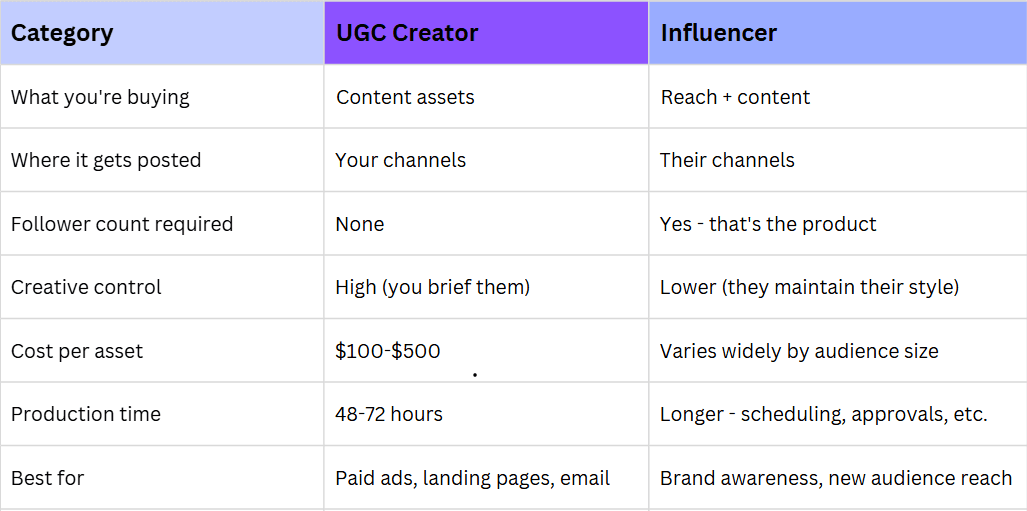
The Core Difference: Content vs. Distribution
This is the clearest way to think about it:
Why UGC Is Dominating Performance Marketing Right Now
Brands are leaning hard into UGC and the numbers back it up.
Social media posts featuring UGC drove 10x higher conversion rates compared to non UGC posts in Q3 2025. UGC based ads achieve up to 4x higher click through rates and 50% lower cost per-click compared to standard brand creative. And including UGC on e-commerce product pages can increase conversions by up to 161%.
The reason isn't complicated: consumers don't trust ads that look like ads. Nearly half of consumers believe most influencer content feels fake or overhyped. But UGC content that looks like something a real person filmed on their couch still reads as genuine. About 92% of consumers trust content from real users more than traditional advertising.
For brands running paid media on Meta, TikTok, or YouTube Shorts, UGC has become the default winning creative format. You can brief a creator today, have finished content in 48–72 hours, test five different hooks, and double down on whichever performs. That's a feedback loop that traditional influencer campaigns simply can't match.
Why Influencers Are Still Irreplaceable
None of that means influencers are obsolete. They solve a different problem.
When you need to introduce your product to a new audience that doesn't know you exist, UGC won't help , it only works when people already land on your ads or pages. Influencers are the mechanism for earned discovery. Their followers trust their recommendations in a way that brand ads never will, and that trust transfers to your product.
Nano influencers on TikTok (under 10K followers) achieve an average engagement rate of 10% the highest of any creator tier on the platform. That's not a vanity metric. That's a highly specific audience paying close attention to someone they actually trust.
Influencers also do something UGC can't: they make your brand feel culturally relevant. A well placed integration with the right creator signals that your product belongs in a certain lifestyle, community, or moment. That's branding, not just conversion and it compounds over time.
How to Think About the Funnel
The cleanest way to deploy both is to map them to where a customer is in their journey:
Top of funnel : Awareness
Use influencers to introduce your product to their audience. Micro and nano influencers in your niche give you targeted reach without the mega influencer price tag. Goal: brand mentions, impressions, first exposure.
Mid funnel : Consideration
Repurpose the best influencer content into retargeting ads. Simultaneously, brief UGC creators on "problem/solution" style videos the kind that say "here's how this fixed my specific issue." Goal: educated shoppers who understand the product.
Bottom of funnel : Conversion
Run UGC as your primary paid creative. Test hooks, angles, formats. This is where UGC earns its keep driving the click, the add-to-cart, the sign-up. Goal: conversions at the lowest possible cost per acquisition.
When to Use UGC Creators
● You're launching a product and need social proof fast
● You're running paid ads and want to test multiple creative angles
● You want authentic content for product pages, email campaigns, or landing pages
● You need a steady content pipeline without blowing your budget
● You want full ownership and rights to repurpose across every channel
When to Use Influencers
● You're entering a new market or audience segment
● You want to build brand awareness and cultural relevance
● You're launching something big and need hype before it drops
● You want long term brand association with a trusted voice in a niche
● You need reach that your own channels can't generate organically
The Honest Take: You Probably Need Both
The "UGC vs. influencers" framing is a false choice. The brands winning in 2026 aren't picking sides , they're using influencers to build awareness at the top and UGC to convert at the bottom.
The mistake is treating them as the same budget line. When you do that, you either hire influencers for content you could have gotten for a fraction of the cost, or you hire UGC creators for reach they were never meant to provide.
Understand what each one is actually selling. Buy the right thing for the right job. Then let them work together.
How Veel Fits In
Veel is built for exactly this. Our platform connects brands with 550,000+ verified creators , both UGC content producers and influencers with real, engaged audiences. You can brief for content only UGC campaigns, run full influencer activations, or do both through the same dashboard.
If you're tired of guessing which creator type to use and when, start a campaign on Veel and we'll help you build the right mix for your goals.