
Jeevan PokharelSeptember 7, 2026
Nano Influencers: What They Are and Why Brands Work With Them
Nano influencers are creators with 1,000 to 10,000 followers. The better question for your influencer marketing strategy is whether this tier fits your campaign or whether a micro influencer would deliver stronger reach or ROI.
This guide explains what nano influencers contribute to influencer marketing, what current benchmarks can and cannot prove, when brands should use them, and how to find, vet, and manage creators without wasting budget or time.
TL;DR
- Nano influencers typically have 1,000 to 10,000 followers. Their smaller communities can be highly engaged, but follower count alone does not prove influence.
- Industry reports often place nano creators at about 76% of Instagram influencers and nearly 88% of TikTok influencers; verify the source, date, and methodology before using these figures.
- Nano engagement benchmarks vary by platform, niche, sample, and calculation method. Reported ranges of 2–5% on Instagram and 9–14% on TikTok are directional, not guarantees.
- A brand may activate 8–10 nano influencers for the cost of one micro influencer, creating more content and testing more audience segments, but management time still matters.
- Nano creators suit niche products, DTC brands, local targeting, authentic content, and engagement-focused campaigns better than broad awareness campaigns that require maximum reach.
- Vetting is essential. Review engagement quality, audience fit, and authenticity before partnering; tools like Veel's Creator Analysis can support manual checks before you commit budget.
What Is a Nano Influencer?
A nano influencer is a social media creator with roughly 1,000 to 10,000 followers. This is a common industry range, not a universal rule: definitions can vary by platform, research firm, and niche. The most useful distinction is not follower count alone, but whether the creator has an active community of engaged followers who trust their recommendations.
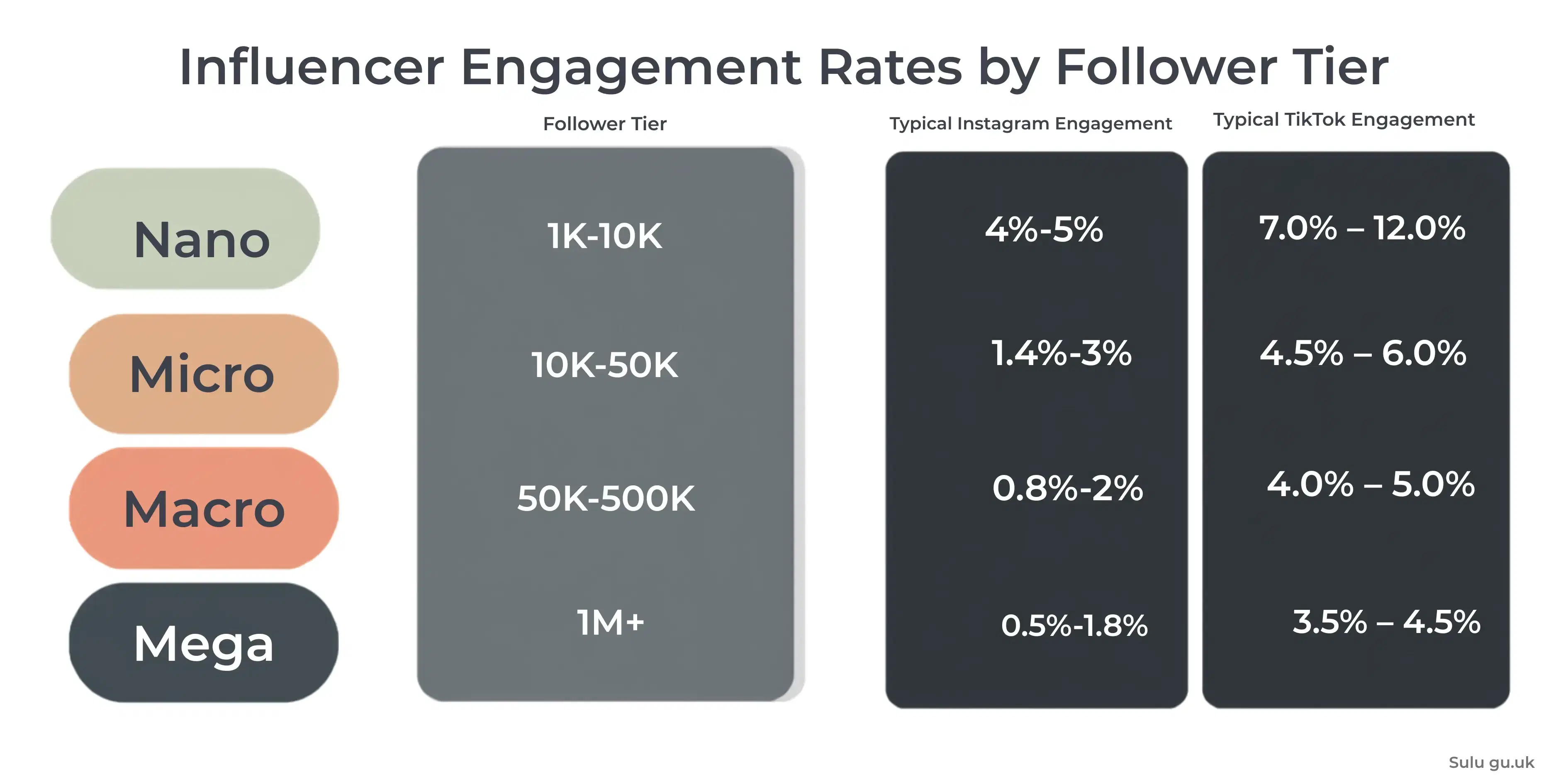
Ranges reflect 2025(2026) benchmark data reported by Influencer Marketing Hub, HypeAuditor, and eMarketer; exact figures vary by study, platform, sample, and niche, so treat these cl
Influencer tiers provide useful context. Nano influencers generally have 1,000 to 10,000 followers; micro influencers have a larger but still focused following; mid-tier, macro, and mega influencers offer progressively greater potential reach. These labels describe scale, not content quality or guaranteed performance. A nano creator may serve a highly specific niche audience, while a larger influencer may reach broader audiences with less topical alignment.
Nano influencers often build their content around a defined niche, such as skincare, food, pets, or fitness. People may respond to their product recommendations as authentic recommendations from a familiar community member rather than as conventional brand advertising. That perceived familiarity comes from consistent interaction, relevant content, and visible audience participation; it does not mean followers personally know the influencer.
That distinction is consistent with the trust data cited by eMarketer. According to Nielsen research cited in that context, 92% of consumers say they trust recommendations from people they know more than recommendations from brands. Nano influencers can benefit from this principle when their content demonstrates expertise, relevance, and authenticity, but trust should be evaluated through engagement quality and audience fit rather than assumed from follower numbers alone.
Nano Influencer Statistics for 2026
The following benchmarks summarize publicly available 2025–2026 research on influencer marketing. Platform statistics, engagement measurements, and market estimates use different samples and definitions, so compare like with like before applying these numbers to a campaign.
- Scale of the tier: Influencer Marketing Hub benchmark data estimates that nano creators represent approximately 75.9% of Instagram influencers and 87.68% of TikTok influencers. Confirm the report date, platform sample, and follower thresholds before using these figures to estimate audience size.
- Instagram engagement: Research attributed to Influencer Marketing Hub, Colorlib, and HypeAuditor-sourced data reported by Shopify commonly places nano engagement around 4% to 5% on Instagram, while mega accounts may average below 1%. Check whether each source calculates engagement from followers, impressions, reach, or another denominator.
- TikTok engagement: Influencer Marketing Hub tracking places nano creators in the low-to-mid teens for engagement in some samples, compared with roughly 1% to 3% for mega creators. These results are not directly comparable with Instagram because TikTok studies may use views or video interactions rather than follower count.
- Gifting performance: Surveys summarized by Social Cat and Influencer Marketing Hub have reported strong engagement for gifted collaborations, but the result depends on the product, creator selection, disclosure, and sample design. Treat gifting as a compensation model to test, not as proof of better campaign results than paid posts.
- Market context: Influencer Marketing Hub estimates that the global influencer marketing industry exceeds $30 billion and continues to grow at a double-digit annual rate. Brands are increasing investment in nano and micro influencers, but market growth does not guarantee reach, conversions, or ROI for every campaign.
A frequently cited case study shows how a brand can use many smaller creators instead of relying on celebrity endorsements. MIT Sloan Management Review documented how sparkling-water brand LaCroix built significant U.S. growth through a broad network of small social media influencers. The example supports the potential of distributed creator partnerships, but it does not prove that nano campaigns alone caused the brand’s success or guarantee similar results for other brands.
A note on the data: engagement rates differ across research firms because of platform sampling, niche, time period, and calculation method. Some metrics use likes, comments, saves, and shares divided by followers; others use views, impressions, or reach. Treat the figures above as planning benchmarks, verify the original reports, and track creator-level results rather than assuming that any tier average predicts conversions or ROI.
Why Nano Influencers Perform Well for Brands
Engagement rates
Nano influencers can generate strong engagement because smaller communities may be more responsive to relevant content. Comments, saves, shares, and meaningful replies reveal engagement quality more effectively than likes alone. However, engagement rate is not the same as reach or conversion performance: a creator may have an active audience without driving clicks or sales. Brands should compare these metrics with campaign objectives and measure results at the creator level.
Niche and local audience fit
A nano influencer who posts about vegan meal prep in Austin may reach the exact audience a plant-based DTC brand wants in that market. A broader creator may offer greater reach, but many followers may have little interest in vegan food or Austin retailers. This Austin example is illustrative, not a research finding. The value comes from topical and geographic alignment, which can improve relevance, trust, and the potential impact of a campaign.
Nano audiences are often self-selected around a niche. For brands, that alignment can make creator content more useful for product education, local discovery, and social proof. A strong fit still requires checking audience demographics, location, content quality, and prior partnerships rather than assuming that every small account will deliver.
Lower cost, easier to scale
Market guides commonly cite nano influencer rates of roughly $10–$150 per Instagram post and $5–$50 per TikTok video, but actual compensation depends on deliverables, audience quality, usage rights, platform, and creator experience. Some creators may accept product gifting, while others expect payment. A lower fee does not automatically produce better ROI: shipping, product cost, compensation, payment processing, approvals, and management time also affect the total cost.
The commonly cited estimate that a brand can activate 8–10 nano influencers for the cost of one micro influencer should be treated as a planning example, not a fixed market rule. A multi-creator strategy can produce more posts, audience segments, and testing opportunities, but it also creates more relationships to coordinate. Veel's Creator Campaigns tool is designed to help brands brief, track, and pay multiple creators, but the platform does not guarantee campaign success or ROI.
Authentic content that converts
Nano influencer content can feel more personal when creators retain a natural voice and disclose the relationship clearly. That authenticity may help audiences pay attention to a product, but it should not be treated as a guaranteed conversion advantage. Brands should give creators accurate talking points without scripting every word, then measure clicks, saves, sales, and conversions against a defined baseline.
Audiences may scroll past polished brand creative but pause for content that reflects a creator's usual style. Nano creators can provide that perspective because their content is often shaped by a specific niche and community. A brand might first publish an organic product demonstration, then negotiate separate usage rights to adapt that post into paid social creative. This approach preserves creator authenticity while letting the brand test paid reach; results still depend on audience fit, creative quality, compensation, and campaign measurement. That is also why this content can become useful UGC a brand can source, whether or not it is formally labeled as influencer marketing.
Nano Influencers vs. Micro Influencers: Which Should You Use?
Nano and micro influencers can both contribute to an influencer marketing program, but they serve different planning needs. Choose between them based on your campaign objective, audience fit, budget, creative requirements, and team capacity—not on follower count alone. In many cases, the strongest strategy uses both tiers with clearly defined roles.
- Choose nano influencers when you need niche or local relevance, multiple content assets, or efficient testing across several audience segments. Their smaller followings may support focused engagement and lower creator fees, but managing many relationships requires more time. Make sure your team can handle outreach, briefing, approvals, compensation, and reporting before launching the campaign.
- Choose micro influencers when you want broader reach from fewer creator partnerships, a potentially more experienced brand partner, or a balance between scale and community engagement. These are general tendencies, not guarantees; compare each influencer’s audience quality, content, rates, and past results. Our complete guide to micro-influencer marketing explains that tier’s costs and use cases in more detail.
A blended influencer marketing campaign can use nano creators for niche content, local credibility, and creative testing, while micro creators extend reach and add fewer, larger distribution points. Give both groups shared brand messaging but tailor the brief to each creator’s audience and format. Use separate tracking links or codes, define different compensation models when appropriate, and evaluate engagement, conversion, ROI, and overall impact by tier. Brands should choose the mix that supports their expected outcomes; neither tier guarantees success, and the right partners are the ones who produce measurable results.
Are Nano Influencers Worth It?
Yes, Nano influencers can be valuable, but their suitability depends on your objective, audience, budget, product, and campaign resources. Before choosing this tier, calculate the full cost: product and shipping, creator compensation, platform or agency fees, usage rights, and staff time for management.
Nano influencers make sense when:
- You are a DTC or ecommerce brand that can ship the product reliably and maintain enough inventory for the campaign.
- Your product fits a defined niche, such as skincare, fitness, pet care, or home cooking, and your target audience is clear.
- You are running a gifting-first campaign and understand that free product is compensation, not a cost-free substitute for payment. The offer should be relevant and clearly disclosed.
- You need hyper-local reach in a specific city, region, or community, and candidate influencers have the right audience location and demographics.
- You want multiple content assets or campaign tests from different creators, and your team can manage outreach, response time, approvals, contracts, shipping, and payments.
- Your primary goals are engagement, product education, social proof, or measurable sales rather than maximum reach from a single influencer.
Nano influencers may be the wrong fit when:
- You need broad awareness quickly. Nano creators can contribute to awareness when activated at scale, but each influencer has limited individual reach.
- Your target audience is very broad, such as everyone aged 18 to 65, with no clear niche or geographic focus.
- You need highly produced, campaign-level creative that requires specialized equipment, extensive direction, or a tightly controlled visual identity.
- You do not have enough management capacity to coordinate a large group of relationships. Twenty or more influencers may require substantially more time than three to five, although the practical threshold varies by team and campaign.
- You lack a system for briefing creators, tracking content and links, approving posts, handling contracts and usage rights, or processing compensation and payments.
Many brands use a combined nano and micro strategy: nano creators can provide volume, niche content, and community-level engagement, while micro influencers can add broader reach. Assign clear roles, use campaign-specific links or codes, and compare engagement, conversion, sales, and ROI by creator tier. This lets you evaluate actual results instead of assuming that one group will perform better.
The main trade-off is coordination. Lower per-influencer fees can be offset by product fulfillment, follow-ups, content review, contracts, usage-rights management, and payment administration. A streamlined workflow can reduce this overhead, which is the purpose of tools such as Veel's Creator Campaigns and Creator Campaign Plan. Verify the current features before relying on either service, and remember that software can support management but cannot guarantee campaign results.
What's Required to Run a Nano Influencer Campaign
Before contacting influencers, prepare the offer, workflow, and measurement plan. These seven steps help brands protect authenticity, manage volume, and give every creator a clear path to producing useful content.
- A reliable product offer. Prepare a product you can ship safely and consistently. It does not have to be low-cost if your margin, inventory, and fulfillment process support the campaign. Include shipping costs in the budget.
- A defined niche and audience. Specify your ideal customer profile, location, interests, and campaign objective so you can select relevant influencers rather than chase numbers.
- A practical written brief. State the objective, deliverables, key and prohibited claims, format, deadline, approval process, disclosure language, tracking links, and usage terms. Keep the brief clear enough to preserve creator authenticity.
- A vetting process. Review audience fit, engagement quality, recent content, brand safety, and signs of artificial activity before inviting creators into the campaign.
- A usage-rights agreement. Separate organic posting rights, permission to repost on brand channels, and paid-media usage rights. Define the channels, duration, edits, exclusivity, and any additional compensation.
- A disclosure policy. A gifted product, payment, or affiliate relationship can create a material connection. Require clear, conspicuous disclosures that follow current FTC guidance and platform rules.
- A system for tracking management tasks. Record outreach, contracts, content status, metrics, links, payments, and results. Whether you use a spreadsheet or Veel, choose a workflow that your team can maintain as the number of partnerships grows.
How to Find Nano Influencers
Finding Nano influencers requires a qualified discovery process rather than a search for the biggest numbers. Define your niche, location, audience, and campaign objective first; then collect candidate profiles, review their recent content, record follower and engagement data, and shortlist creators whose quality and style fit your brand.
Hashtag and niche search on Instagram and TikTok
Start on Instagram and TikTok with specific hashtags related to your product, niche, and market. Instead of relying only on broad terms such as #skincare, test focused searches such as #veganskincareuk or #homegymsetup. Review accounts with approximately 1,000 to 10,000 followers, consistent posts, relevant content, and genuine engagement. Hashtag volume does not prove creator quality, so examine comments, audience fit, and content authenticity before adding an account to your list.
On TikTok, search category terms and recent posts to discover creators whose style already suits your influencer marketing strategy. Save promising profiles, note their typical reach and engagement, and personalize outreach around a specific post or shared audience need. Track replies and follow-ups so discovery time leads to organized partnerships rather than an unmanageable list.
Brand mentions and tagged posts
Check your own tagged posts, mentions, and customer content before starting cold outreach. Customers who already use your product may have earned audience trust and can become strong influencer partners when their niche and content fit your campaign. Veel's Social Media Audit tool can help identify who is already discussing your brand across platforms; verify its current coverage and features before relying on it for discovery.
Influencer platforms and marketplaces
Manual research can reveal relevant Nano influencers, but many databases set minimum follower thresholds that exclude them. A dedicated platform may help brands find creators and organize campaign management, but a small following does not guarantee quality. Confirm that the platform supports the functions you need, including creator discovery, contracts, contracts, payments, usage rights, and performance tracking. Use the tool to narrow a qualified shortlist, then review each influencer manually before inviting them to a partnership.
What to Check Before You Partner
Vetting matters at every influencer tier, including Nano influencers. A high engagement rate can be useful, but it cannot prove authenticity by itself. Review the creator's content, audience, history, and performance signals before committing campaign budget.
- Engagement quality over quantity. Review comments, saves, shares, and replies across recent posts. Genuine conversations provide more context than likes alone, while generic comments or sudden spikes may require further investigation. Compare average views with follower numbers and do not treat one metric as proof of influence.
- Audience demographics. Confirm that the creator's audience location, age, interests, and language match your market. A creator may have strong reach but limited value if most followers live outside the countries or regions where your brand operates. Request current platform insights when the data is important to the decision.
- Content consistency. Review the last 20 to 30 posts. Check posting frequency, format, visual quality, message consistency, and whether the creator can explain products clearly. An irregular posting history may affect campaign timing and results.
- Past brand partnerships. Review sponsored content for disclosure, clarity, brand safety, and audience response. Check whether the creator has recently promoted competitors or works with so many brands that trust and content quality could suffer.
- Suspicious growth or activity. Look for sudden follower increases, unusually repetitive comments, low views relative to followers, or generic profiles among the audience. Smaller accounts are not automatically fraudulent, so use several signals and request first-party insights when needed.
Manual checks take time across dozens of candidates, so tools can support the review process. Veel's Creator Analysis tool states that it can provide information about engagement rate, audience quality, and authenticity for Instagram, TikTok, and YouTube. Confirm its current coverage, data sources, and free-access terms before relying on any report. Use automated metrics to prioritize candidates, then combine them with human review before approving a partnership.
How to Work With Nano Influencers
Working with Nano influencers requires clear expectations and respect for the creator’s existing voice. Set the objective, deliverables, compensation, approval process, and timeline before the campaign begins, then give creators enough flexibility to produce authentic content.
Gifting vs. paid. Gifting, flat fees, affiliate compensation, and hybrid models serve different purposes. A gifted product may be appropriate when the creator genuinely wants to try it, but it is still a cost and may create a material connection that requires disclosure. Do not require a positive review or unsupported claim. If the content, engagement, or sales meet agreed expectations, consider a paid or commission-based partnership. Veel's gifting and affiliate tools, described in the affiliate program overview, may support this process; confirm current features before relying on them.
Keep the brief simple. State the campaign goal, product facts, required deliverables, key claims, prohibited claims, format, deadline, approval steps, tracking links, and payment terms. Avoid scripting every sentence or imposing a lengthy brand guide; creator flexibility helps protect authenticity while keeping the message accurate.
Content usage rights. Agree in writing on the duration, channels, territory, edits, exclusivity, and renewal fees. Organic posting rights, reposting on brand channels, and paid-media usage or amplification are different permissions and may require different compensation. Explain whether the brand can crop, edit, whitelist, or use the content in ads before the creator publishes.
FTC disclosure. Under the FTC's Endorsement Guides (16 CFR Part 255), a paid relationship, gifted product, affiliate link, or other material connection may require clear and conspicuous disclosure. Use language such as “Ad” or “Sponsored,” or an appropriate platform label, where applicable. The FTC has stated directly that disclosures should be easy to notice and understand. Brands and creators share responsibility for compliant communication, so review current FTC and platform requirements or obtain legal advice when needed.
Think long-term. Pay on the agreed schedule, provide useful feedback, and evaluate partners by content quality, audience fit, engagement, and conversion results rather than follower count alone. Creators who perform well can become reliable partners in a three-to-six-month partnership. Repeat collaborations can build trust and improve campaign management, but renew them based on measurable performance and a strong working relationship.
Sources: Influencer Marketing Hub Benchmark Report (2025–2026), eMarketer, Shopify, MIT Sloan Management Review, and the FTC's Endorsement Guides. Engagement-rate ranges are aggregated across multiple 2025–2026 industry reports and should be used as directional figures. Verify source methodology, current legal guidance, platform requirements, and product-tool features before making campaign decisions.
To Wrap It Up: Why Nano Influencers Matter for Small Brands
Nano influencers can help small brands reach relevant communities without a celebrity-sized budget. Their value comes from niche relevance, authentic content, local targeting, and measurable engagement—not follower count alone.
Choose this strategy when your audience and product fit the creator’s niche, and track reach, engagement, sales, conversions, and ROI. Use larger influencers when broad reach is the primary goal, and follow disclosure requirements in every campaign.
To save time managing creators and campaigns, explore Veel and verify its current pricing, creator network, and automation features before choosing a plan.
For the next step, read the UGC Creator Guide and learn how creator content can support your influencer marketing campaigns.
For a broader comparison, see UGC vs. Influencer Marketing.