
Richa tandukarOctober 30, 2026
Prada Drew Its Holiday Campaign by Hand. Every Brand Running Ads in 2026 Should Be Taking Notes.
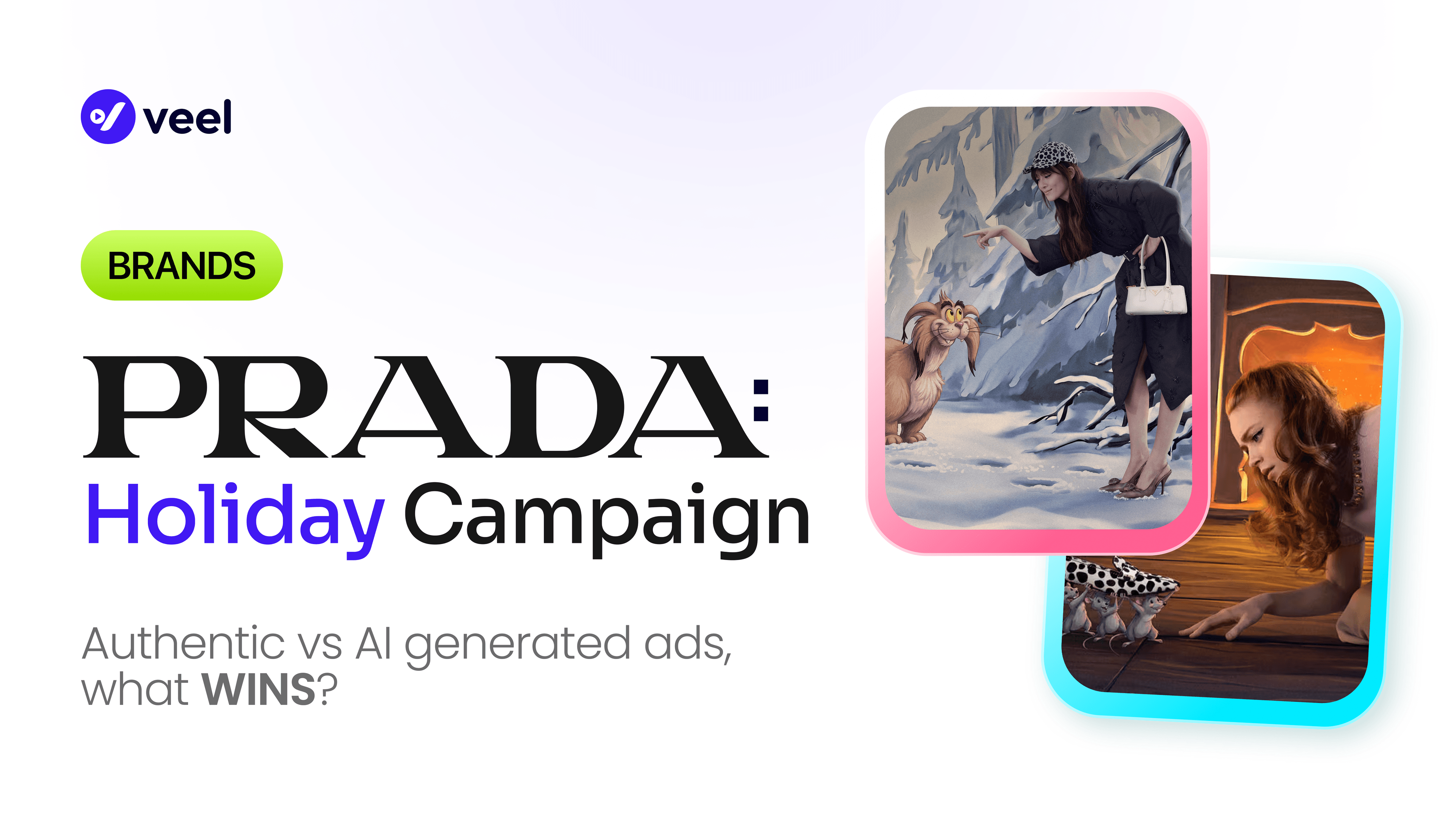
On 27 October 2026, Prada released its holiday campaign. No generative AI. No render farm. A pencil.
"Drawing Prada: Animated by Hand" places Sadie Sink, Maya Hawke, Kelvin Harrison Jr., Chen Haoyu and Luther Ford inside a hand-drawn winter storybook. Cartoon mice carry off Sink's shoe. A fox trails Hawke through the snow. A snow lynx chases Haoyu's handbag. It was photographed by Glen Luchford, creative-directed by Ferdinando Verderi under Miuccia Prada and Raf Simons, and animated by John Pomeroy - the ex-Disney animator behind An American Tail and The Land Before Time, with Tom Bancroft (Mulan) also on the team.
Then Prada did the thing that actually made it a strategy instead of a pretty ad.
They released a second film showing the pencil.
A behind-the-scenes cut of an artist's hand moving across paper. The making-of. And across the trade press and social, that second film got more praise than the campaign itself.
That's not a charming extra. That's the whole play.
The campaign isn't selling handbags. It's selling hours.
Luxury has always priced the labour inside the object , the stitching, the leather, the hours of a person who knows what they're doing. What Prada did here was apply that exact logic one level up: to the advertising itself.
Hand-drawn cel animation is slow. It's expensive. It cannot be prompted into existence at 2am. And in 2026, that's the point. The production cost is the brand argument.
It also arrived at a very convenient moment. Prada Group posted 2025 net revenues of €5.718B, up 9% - but Prada-brand retail sales were down 1%, with group growth carried by Miu Miu. A warm, high-craft, emotionally legible campaign is precisely what a house needs when it has distribution but needs desire.
The foil was already in place
Prada didn't have to attack anyone. The category had spent two years supplying the contrast:
- Coca-Cola ran AI-generated holiday films in 2024 and again in November 2025. Viewers called them "soulless" and "digital slop." CARMA's sentiment tracking showed positive reactions falling from 23.8% before the campaign to 10.2% after.
- Valentino released a fully AI-generated handbag campaign in late 2025. Commenters called it "cheap" and "lazy." It was pulled.
- McDonald's Netherlands pulled an AI Christmas spot the same season.
Against that backdrop, a pencil reads as a flex.
The data says audiences were primed for this
This isn't vibes. The 2026 research is unusually consistent:
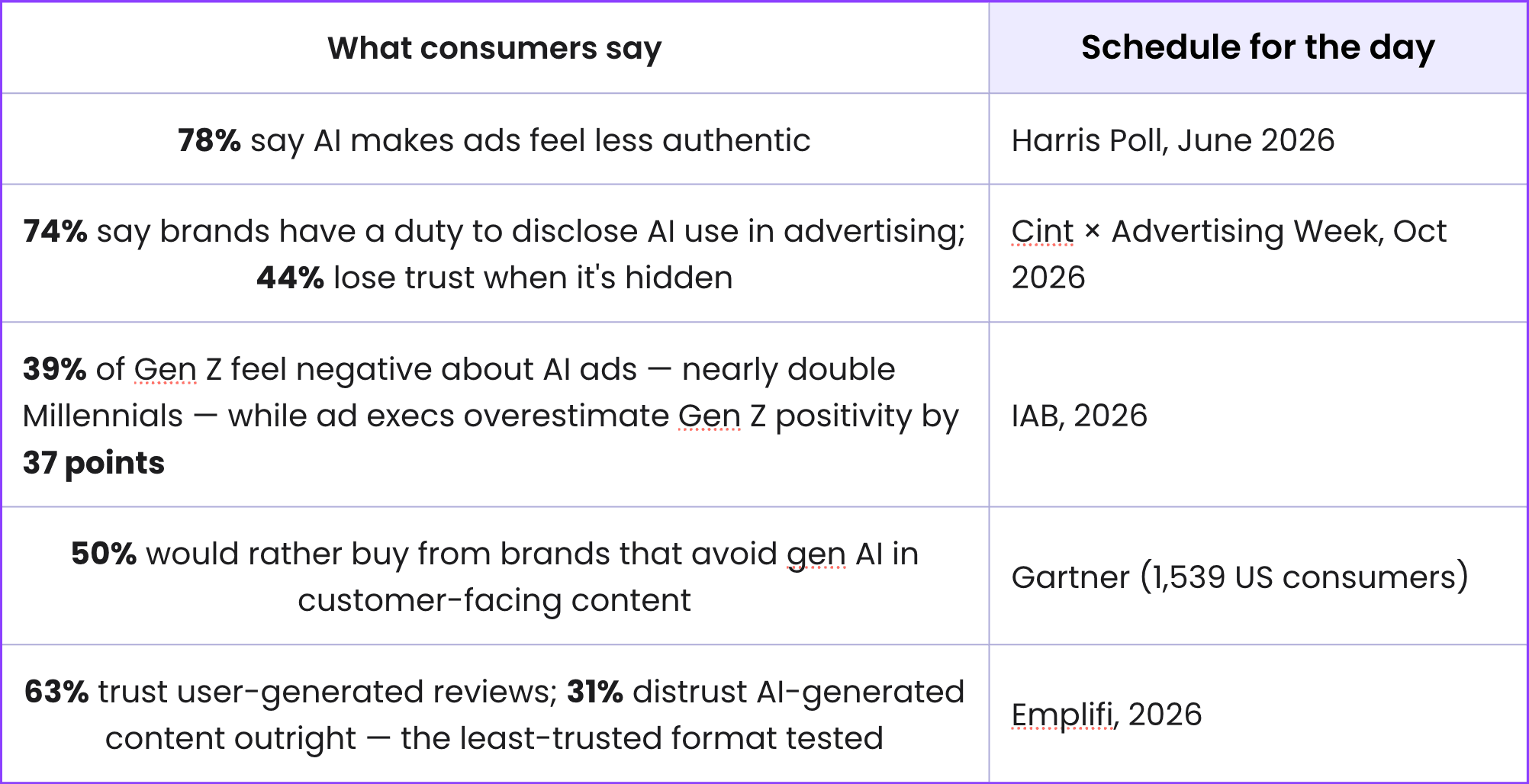
And from the Journal of Advertising Research: when luxury brands disclose AI imagery, consumers perceive less effort and discount brand authenticity accordingly.
Effort is the variable. Not the tool.
Here's the part most hot takes get wrong
Two inconvenient facts, because you should know them before you build a strategy on this:
1. Most people can't actually tell. An Ipsos/Syracuse Newhouse study (May 2026) found only 13% of viewers were confident an ad was AI-made - and the same share wrongly flagged human-made ads as synthetic. Audiences are not running detection software. They're reacting to feel.
2. The proof doesn't travel. The "made by hand" story lives in the process film and the press cycle. On a billboard, in a magazine spread, in a 6-second pre-roll, "Drawing Prada" is just a nice drawing. The craft signal is expensive to make and easy to lose in distribution.
So what actually went wrong for Coca-Cola and Valentino wasn't that they used AI. It's that the audience could see them spending less. AI was the evidence, not the crime.
Which gives you the real rule:
Don't be the brand that looks like it stopped trying.
Four things you can steal from Prada without a Disney budget
You can't hire John Pomeroy. You can run the mechanics.
1. Ship the making-of, not just the ad
The behind-the-scenes film was the most-praised asset in a campaign that cost a fortune. A process cut costs you almost nothing and does most of the credibility work. Film the shoot. Film the edit. Film the creator unboxing it badly on the first take.
2. Put a human name on the work
"Animated by John Pomeroy" carries weight that "animated" does not. Credit your creators by name and handle. Attribution is free authenticity.
3. Let the audience draw the anti-AI conclusion
Notice that Prada's own copy talks about craft and hand and storytelling — the "antidote to AI slop" framing came from the press, not from Prada. That's deliberate. Declaring "we don't use AI" creates a compliance burden you have to defend forever. Showing the pencil doesn't.
4. Find the version of "made by humans" that actually scales for you
This is the hard one. Prada's answer was cel animation. For a DTC or ecommerce brand shipping dozens of assets a month, hand-craft doesn't scale - and shouldn't.
Your scalable version of human is real creators.
What this means if you're not a luxury house
A creator holding your product in their kitchen is the most structurally AI-proof asset in your library. It has a name attached. It has a face. It has a posting history. It has the small imperfections that generative models smooth away -and that audiences read as true.
That's exactly the asset class Veel was built around:
- 550K+ verified creators: real people with real audiences, matched to your brief, with full usage rights from day one
- AI authenticity checking : so you can tell genuine UGC apart from AI-generated submissions before it ever reaches your feed
- AI Lens: scans six platforms for real video mentions of your brand, so authentic content you didn't commission still works for you
- One-click embeds for Shopify, WooCommerce and Webflow - put proof on the product page, where it converts
- Content Library + auto-posting to Meta, TikTok and YouTube, so human-made assets get distributed at machine speed
The lesson from "Drawing Prada" isn't avoid AI. Prada used plenty of technology to make and distribute that campaign. The lesson is put humans where the audience is looking, and use AI for everything behind the curtain - matching, sourcing, rights, payouts, scheduling, moderation.
Human at the front. Automation at the back.
That's the whole strategy, and it's the one Prada just spent a very large amount of money demonstrating in public.
The holiday window closes fast
Q4 is where this gets tested. Your competitors are about to flood every feed with the same four generative-AI winter scenes, and audiences have already told pollsters exactly how they feel about that.
A pencil was Prada's differentiator. A real person holding your product is yours.
Start a creator campaign on Veel →
FAQs
What is the Prada Holiday 2026 campaign? "Drawing Prada: Animated by Hand," released 27 October 2026. It combines Glen Luchford's photography of Sadie Sink, Maya Hawke, Kelvin Harrison Jr., Chen Haoyu and Luther Ford with hand-drawn 2D animation directed by ex-Disney animator John Pomeroy, under creative directors Miuccia Prada and Raf Simons.
Did Prada use AI in its holiday campaign? The animation was drawn by hand by a team of veteran animators, and Prada released a behind-the-scenes film documenting the process. Prada's own campaign copy emphasises craft rather than making an explicit anti-AI claim.
Why are consumers reacting badly to AI-generated ads? 2026 research points to perceived effort, not technology. A Harris Poll found 78% say AI makes ads feel less authentic, and Journal of Advertising Research work shows consumers discount brand authenticity when AI imagery is disclosed because they infer less effort was spent.
How can smaller brands apply this without a luxury budget? Show your process, credit humans by name, and build your content library from real creators rather than synthetic imagery. Platforms like Veel source verified creators, verify content authenticity, and handle rights and payouts so human-made content scales.