
Jeevan PokharelAugust 4, 2026
Micro vs Macro Influencers: Which Tier Converts Best in 2026?
TL:DR
Influencer marketing has shifted from “who has the most followers?” to “who actually converts?” in just a few years. The industry surpassed roughly $32–33B by 2025, with creator spend growing around 26% year‑over‑year, and 2026 budgets are now under pressure to prove real ROI. As more brands move away from vanity metrics, the micro vs macro debate has become a question of cost per acquisition, not just impressions.
Before you can decide which tier converts best, you need a clean definition. Most 2026 guides and benchmark studies cluster tiers roughly like this.
Nano: 1K–10K followers
Micro: 10K–100K followers
Mid‑tier: 100K–500K followers
Macro: 500K–1M followers
Mega/Celebrity: 1M+ followers
This structure appears across 2026 tier‑based ROI studies that tracked 92+ brand–creator partnerships and surveyed hundreds of marketers. Why these ranges? Because they map to real differences in audience behavior, cost, and creator incentives:
Nano and micro creators tend to know their audience personally, reply to comments, and build tight communities.
Mid‑tier and macro creators trade some intimacy for broader reach and more professional content operations.
Mega/celebrity accounts operate more like media outlets than peers — they deliver fame and PR, but at a premium.
The 2026 Data: Engagement, Cost, And Conversion
The heart of the debate is simple: do smaller creators actually convert better, or do they just look good on engagement rate screenshots?
Side‑By‑Side Benchmarks: Micro vs Macro
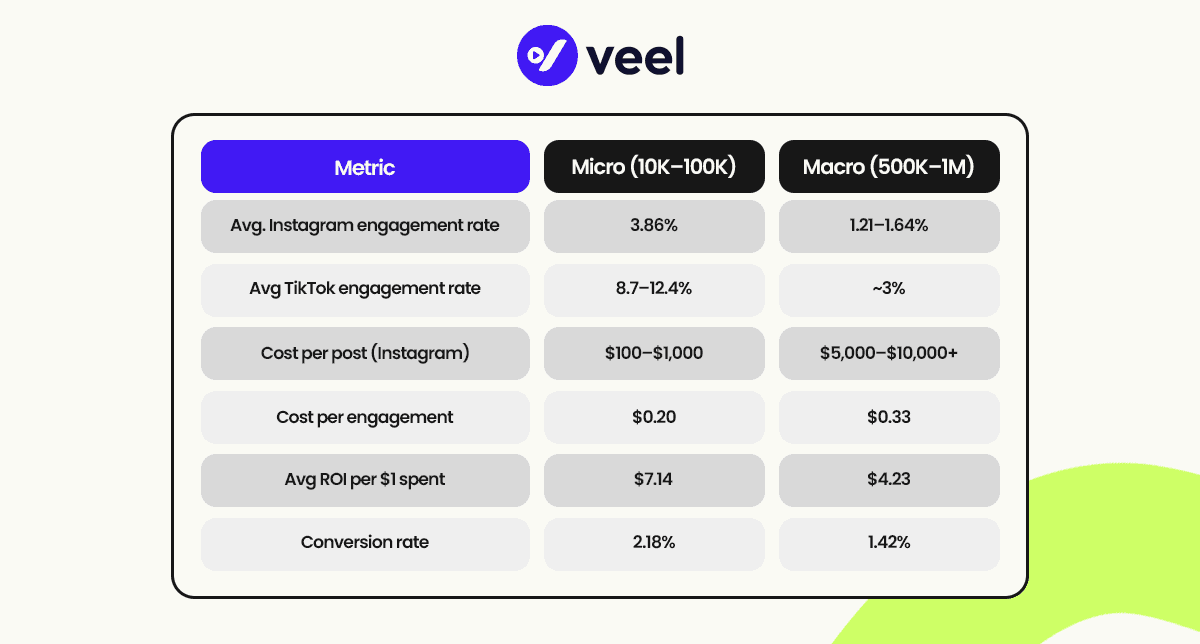
A 2026 benchmark from Draper and Influencer Marketing Hub lays out the numbers clearly.
Micro‑influencers are cheaper to reach, cheaper to engage, and more likely to convert. The advantage compounds: every step from impression to click to purchase is slightly more efficient, so the gap in actual sales grows quickly, especially when you run multiple creators in parallel.
Nano And Micro: The Quiet Conversion Monsters
The story doesn’t stop at micro. Stack influence’s 2026 partnership data (carried into multiple blogs) highlights how powerful nano creators can be: roughly 7% of their engagements converted to sales, more than double the ~3% conversion rate seen with macro influencers. Nano and micro tiers are the high‑trust end of the spectrum:
- Their followers see them as peers, not celebrities.
- Sponsored posts feel like honest recommendations rather than ads.
- Their content often triggers meaningful comment threads where they can answer questions and reduce friction right before purchase.
In practical terms, if you care about cost per acquisition rather than CPM, the data says: start with nano and micro, then layer in higher tiers as your budget and goals expand.
Macro And Mega: Still Valuable, But For Different Goals
Macro and mega creators do not disappear in 2026; their role changes. Markhub24’s ROI analysis shows that macro and celebrity talent remain strong drivers of brand lift and awareness, especially for global campaigns. They bring:
- Instant reach and recognition across multiple markets.
- A halo effect: being associated with a famous name can increase trust at a brand level, even if the specific post doesn’t convert as efficiently.
However, the same study notes that macro and mega campaigns typically deliver lower ROI per dollar compared to a diversified portfolio of micro and nano creators, once you factor in their higher fees and weaker per‑follower engagement. For conversion‑driven campaigns, macro tiers are best at feeding the top of your funnel, not closing the sale.
Beyond Engagement: What Actually Drives Conversion?
One of the big warnings in 2026 thought leadership is that follower count alone doesn’t guarantee performance ; even within the “good” tiers. Draper’s blog gives examples of micro creators with 30K followers performing below macro benchmarks on engagement because their content, audience, or brand fit is wrong. So what really drives conversion?
Audience–Offer Fit
Brands that win with micro creators do one thing consistently well: they ensure the creator’s audience overlaps meaningfully with the brand’s buyer persona.
A micro fitness creator promoting a new Kathmandu‑based gym app will outperform a macro lifestyle celebrity whose audience spans many countries and interests.
A micro fintech educator talking about savings and local banking will convert better for a regional finance product than a mega celebrity delivering a generic endorsement.
Trust, Authenticity, And Communication Style
Conversion is ultimately about trust. 2026 strategy guides, including Influence Flow’s comprehensive influencer marketing guide, argue that authenticity and long‑term relationships matter more than any individual post.
- Micro and nano creators have several trust advantages:
- They respond to DMs and comments, so followers feel seen.
- They share more personal stories, failures, and behind‑the‑scenes content.
- They integrate sponsorships into their usual content formats rather than “breaking” their style for an ad.
This creates high‑intent traffic: when they mention your link in bio, viewers arrive expecting value, not just entertainment. That’s why app install studies in 2026 show micro‑influencers producing lower cost per install and higher install‑to‑retention ratios than macro influencers.
Content Format And Platform Differences
Conversion also depends on where and how creators post. Lookfluence’s 2026 CPA benchmarks show significant variance by format and platform: short‑form video on TikTok or Reels tends to deliver lower CPA than static feed posts if the creator has an engaged audience.
Key patterns across platforms:
- TikTok: Micro creators’ 8.7 - 12.4% engagement rates drive strong clickthrough and impulse purchases, particularly for affordable consumer products and mobile apps.
- Instagram: Micros maintain an edge, but you need a mix of Reels, carousels, and Stories to move people from discovery to purchase.
- YouTube: Mid‑tier and macro creators can actually perform well on conversion when they have deep, tutorial‑style content that lets them educate and pitch over 10+ minutes.
Choosing The Right Tier Mix
The most useful 2026 guides, including Promote’s and several ROI comparison pieces for DTC brands, converge on one idea: don’t pick a single tier; design a tier mix around your funnel.
Map Tiers To Funnel Stages
A practical framework looks like this.
Top of funnel (Awareness & Reach)
- Dominant tiers: Macro, mega, some mid‑tier.
- Objectives: Impressions, search volume, social listening uplift.
- Tactics: Big launch campaigns, hero video collaborations, press coverage.
Mid‑funnel (Consideration & Education)
- Dominant tiers: Micro and mid‑tier.
- Objectives: Clicks, time on site, email sign‑ups, app installs.
- Tactics: Tutorial content, honest reviews, multi‑post series, live Q&A.
Bottom of funnel (Conversion & Retention)
- Dominant tiers: Nano and micro.
- Objectives: Purchases, upgrades, referrals, repeat usage.
- Tactics: Discount codes, affiliate programs, user stories, community challenges.
This funnel‑based allocation is backed by data from DTC‑focused agencies that show brands achieving better blended CPA when they use macros for launch spikes and micros/nanos for evergreen performance.
Budget Allocation By Tier
ROI‑by‑tier analysis and similar studies propose budget splits that many brands have adopted: roughly 60–70% of influencer budget toward nano and micro creators, 20–30% toward mid‑tier, and the remaining 10–20% toward macro/mega talent.
Why allocate this way? Because:
- Nano/micro creators deliver the best cost‑per‑engagement and cost‑per‑conversion.
- Mid‑tier creators help you scale while maintaining some intimacy and trust.
- Macro/mega partners are expensive and should be reserved for moments where their branding uplift justifies the cost.
Answering The Question: Which Tier Converts Best In 2026?
Taking the 2026 evidence together, we can now give a clear, nuanced answer.
- For pure conversion (sales, installs, sign‑ups), micro‑influencers are the best‑performing tier for most brands. They deliver higher engagement, better cost‑per‑engagement, and stronger conversion rates than macro influencers, with ROI often in the $7+ range per $1 spent versus roughly $4 for macros.
- Nano‑influencers can outperform micro creators on a per‑engagement basis, with some studies showing around 7% of engagements converting to sales compared to roughly 3% for macro influencers, but their smaller audiences limit total volume.
- Macro‑influencers remain valuable for top‑of‑funnel goals — they convert less efficiently per follower, but their reach and branding impact can justify their cost when awareness, not CPA, is the main KPI.
So the honest answer to “Which tier converts best in 2026?” is:
- Micro‑influencers are your best default choice for performance‑driven campaigns.
- Nano creators are your secret weapon when your product and their audience align tightly.
- Macro and mega creators are strategic amplifiers, not primary conversion engines.