
Jeevan PokharelOctober 7, 2026
UGC Ad Hooks: 25+ Examples for Facebook Ads
You can film a great UGC ad and still lose it in the first two seconds. Nobody sees your demo, your proof, or your offer if they've already flicked past.
That's why UGC ad hooks are the first thing to test on Facebook, and the cheapest thing to change. This post gives you 26 hooks you can copy, sorted into eight types, with what to say, what to show, and when each one fits. After the list you'll get a fill-in-the-blank formula, a simple way to test hooks without reshooting the video, and the mistakes that quietly wreck hook rate.
If the rest of your ad isn't set up yet, start with our guide to UGC video ads for Facebook, then come back here.
Quick answer: what is a UGC ad hook? A UGC ad hook is the first one to three seconds of a user-generated video ad: the spoken line, the on-screen text, and the opening shot that stop someone from scrolling. On Facebook, the hook decides whether anyone sees your offer at all. It's the first thing to test and the cheapest thing to change.
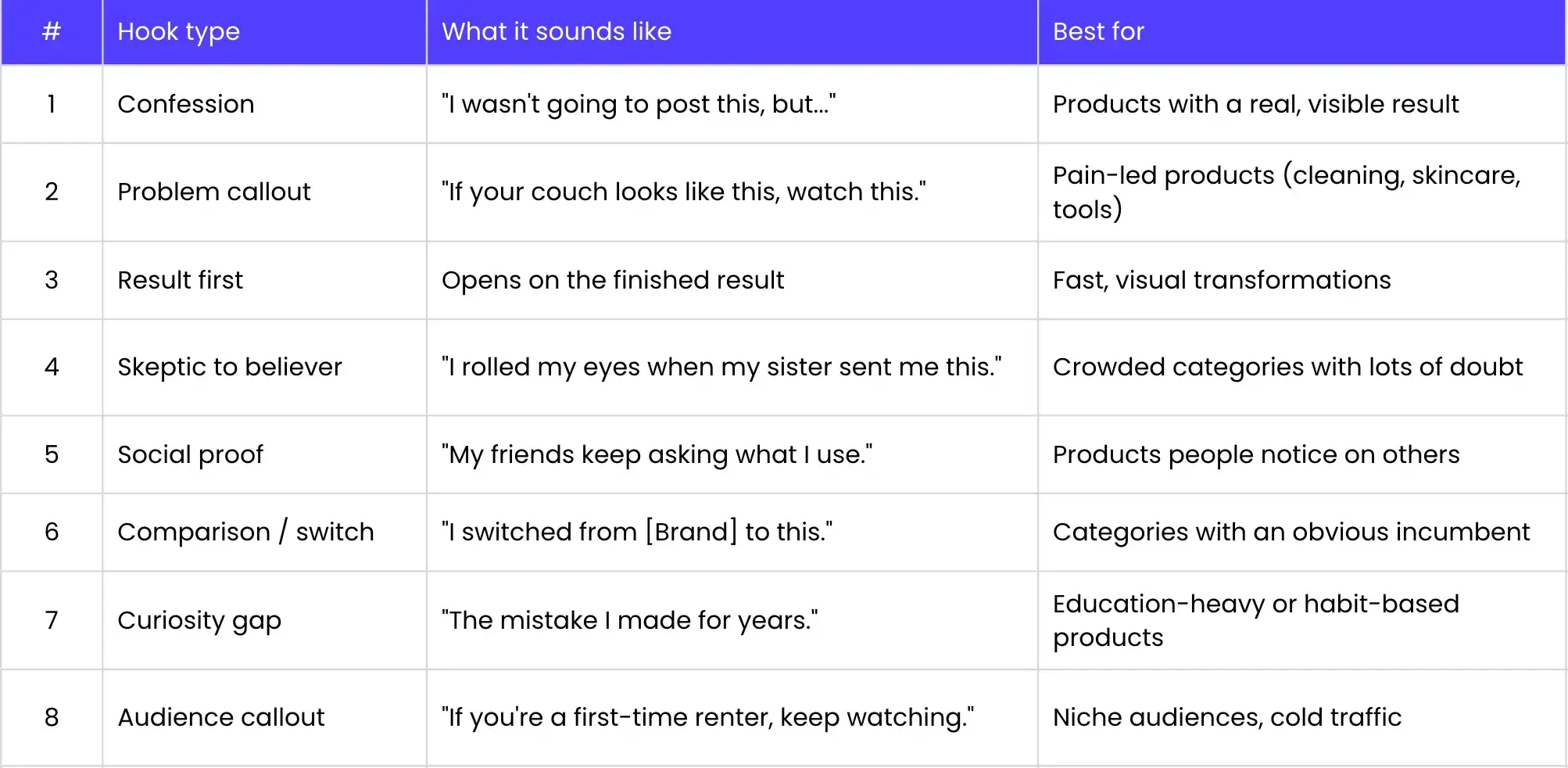
The 8 Types of UGC Ad Hooks at a Glance
What Makes UGC Ad Hooks Work on Facebook
Picture someone on a bus at 6:40 p.m. Thumb moving. Friend's vacation photo, a recipe, an ad, another ad. Each one gets maybe a second. The ones that survive don't look like ads and don't sound like ads, and they say something that feels aimed at that exact person.
A good hook does three jobs at once:
- Stops the thumb. Movement, a surprising first frame, or a line that sounds like a person rather than a brand.
- Signals who it's for. "That's me" is the fastest route to the next second.
- Opens a loop. The viewer needs a reason to stay for the answer, whether that's the result, the product, or the reveal.
Facebook adds two wrinkles. Your ad runs in Feed, Stories, and Reels, so vertical 9:16 is the safe default. And plenty of people watch with the sound off, so a hook that only works as audio is half a hook. Put the line on screen too.
26 UGC Ad Hook Examples You Can Copy
Each hook below has the line to say, what to show on screen, and where it fits. Swap the brackets for your product. Keep the wording loose. A creator who reads these like a script will sound like a script, so hand them the idea and let them say it their way.
Type 1: Confession Hooks
These sound like a friend lowering their voice. They work because they don't sound like a pitch.
1. "I wasn't going to post this, but..." Show: mid-action, creator already using the product. On-screen text: the first five words. Fits: any product with a real result.
2. "Okay, I owe you all an update." Show: creator back on camera after 30 days, holding the product. Fits: retargeting, or any product people need time to judge.
3. "Nobody asked, but this is the only [product] I'll buy again." Show: a shelf, drawer, or bag with the product in it. Fits: repeat-purchase items like skincare, coffee, and supplements.
4. "I've used this for 90 days. Here's the honest version." Show: worn, used product (not a pristine one). Fits: higher-priced items where trust is the sticking point.
Type 2: Problem Callout Hooks
Lead with the pain. The viewer should think "wait, that's literally me" before the creator says a word.
5. "If your [thing] looks like this, watch this." Show: the problem up close. A stained cushion, a cracked heel, a tangled cable drawer. Fits: cleaning, repair, beauty, home.
6. "Why does nobody warn you about [specific annoyance]?" Show: the annoyance happening, not the creator explaining it. Fits: parents, new homeowners, new pet owners.
7. "This is what [problem] looks like at 7 a.m." Show: unfiltered morning-light footage, no styling. Fits: routines, sleep, productivity, skincare.
8. "POV: you've tried everything for [problem] and nothing worked." Show: a quick pile of failed attempts, then the product. Fits: stubborn problems with lots of failed fixes.
Type 3: Result-First and Pattern Interrupt Hooks
Skip the setup. Start where the story ends, or start somewhere strange.
9. "Look at this first, then I'll explain." Show: the finished result in frame one, held for a beat before any talking. Fits: visual transformations like cleaning, hair, makeup, organizing.
10. [Cut open mid-action: the spray, the pour, the zip.] Show: the product doing its job with bold text, "Day 1 vs. Day 14." Fits: products with a satisfying or fast visual.
11. "Three seconds. Watch what happens." Show: a single-take demo where the result lands inside the window. Fits: instant-result products. If the result takes a week, don't use this one.
Type 4: Skeptic-to-Believer Hooks
You've likely felt this one yourself. Someone recommends a thing, you roll your eyes, then you quietly order it.
12. "I rolled my eyes when my sister sent me this." Show: a text thread or the product still in its packaging. Fits: crowded categories where viewers have been burned.
13. "I bought this to prove it wouldn't work." Show: creator holding the product with a "let's see" expression. Fits: products with big claims. Only use it if the product holds up, because this hook invites scrutiny.
14. "Everyone kept recommending this and I kept ignoring them." Show: creator finally unboxing. Fits: products with a strong word-of-mouth reputation.
Type 5: Social Proof Hooks
The proof is built into the opening line, so it works before the viewer has any reason to trust you.
15. "My friends keep asking me what I use on [thing]." Show: creator in an ordinary setting, the visible result in the shot. Fits: beauty, hair, fashion, and anything others notice on you.
16. "This has [real number] reviews and I finally get why." Show: the review count on a screen, then the product. Fits: marketplace and e-commerce listings. Use a true number or skip this one.
17. "I showed this to [my mom / my trainer / my vet] and they asked for the link." Show: the second person in frame, or their reaction. Fits: any product where a specific expert's approval carries weight.
Type 6: Comparison and Switch Hooks
Comparison hooks borrow an existing opinion and redirect it.
18. "I switched from [Brand] to this and here's what changed." Show: both products side by side. Fits: categories with an obvious incumbent.
19. "I stopped paying [amount] for [category] when I found this." Show: the receipt, subscription page, or old product in the trash. Fits: price-led offers and subscription swaps.
20. "[Cheaper thing] vs. [this]: I tested both." Show: a split-screen test with a clear winner. Fits: products that can be shown beating a familiar alternative.
Type 7: Curiosity Gap Hooks
These promise information, not a product. The viewer stays because the answer is still missing.
21. "There's one thing about [category] nobody tells you." Show: creator pointing at the product detail that matters. Fits: education-heavy categories like skincare, supplements, and software.
22. "Stop doing [common habit] if you want [result]." Show: the habit, then a red X over it, then the fix. Fits: habit-based products. Keep the claim honest and specific.
23. "The mistake I made with [category] for years." Show: creator doing the "wrong" thing on camera. Fits: anything with a learning curve.
Type 8: Audience Callout Hooks
The simplest way to qualify the right viewer is to name them. This is especially useful with cold traffic.
24. "If you're a [dog owner / night-shift nurse / first-time renter], keep watching." Show: a visual that matches the audience, like the leash, the scrubs, the empty apartment. Fits: niche audiences.
25. "Parents of toddlers: this one's for you." Show: a believable, slightly chaotic household scene. Fits: family products.
26. "For anyone who's [specific situation] and [specific constraint]." Show: the constraint itself. A tiny kitchen, a tight budget, a ten-minute morning. Fits: products sold on a trade-off.
A note on audience callouts. Meta's advertising standards restrict ads that imply you know personal attributes about the viewer, such as health conditions. Stick to roles and circumstances ("dog owner," "first-time renter"), not diagnoses or sensitive traits ("Are you struggling with [condition]?").
Visual and Text Hooks: The First Frame Matters as Much as the Line
A hook isn't only what's said. Viewers read the first frame before they hear anything.
- Show the thing in frame one. The product, the problem, or the result. Not a logo, not a wide shot of a room.
- Keep on-screen text to about seven words. Big, high contrast, placed away from the edges where Facebook's interface covers it.
- Burn in captions from the first second. If someone's watching on mute, captions are the hook.
- Add motion early. A hand entering the frame, a pour, a cut. A still shot reads as an ad.
- Put the face in frame fast. Real faces feel like people, and people feel like UGC.
Hooks also work in layers. A spoken line, a text overlay, and the opening shot can each carry a different hook, which means one video can hold several tests at once.
How to Write Your Own UGC Ad Hook: A 3-Part Formula
When the 26 above don't fit your product, build one from three pieces:
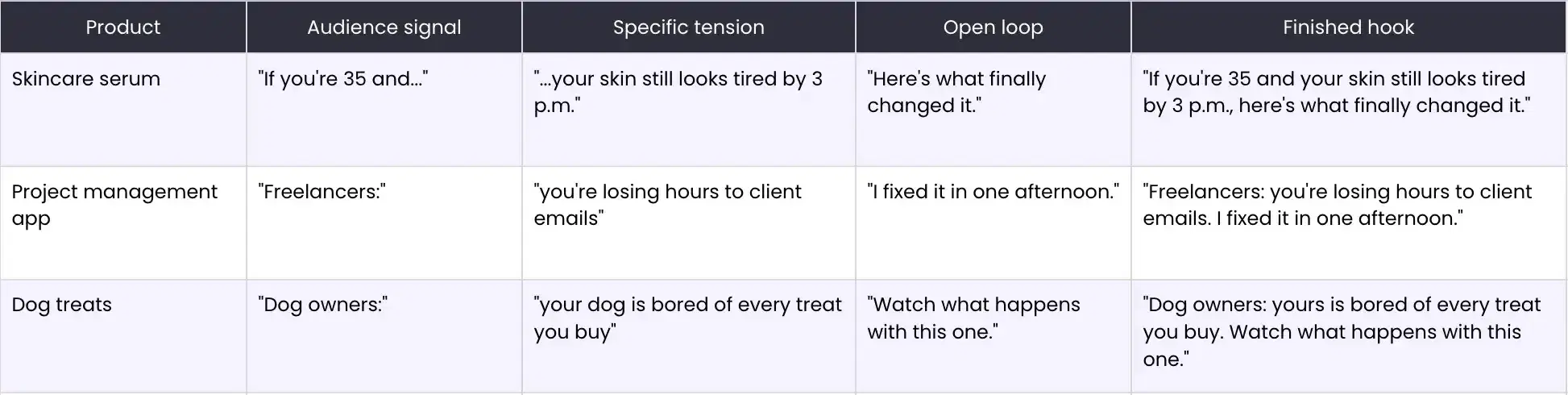
Specific beats clever every time. "Tired by 3 p.m." gives the viewer something to recognize. "Struggling with skin" doesn't.
Stuck on angles? Veel's free Content Idea Generator maps the audiences and use cases your product could speak to, which gives you raw material for new hooks you haven't tried.
Which UGC Ad Hooks Fit Which Audience
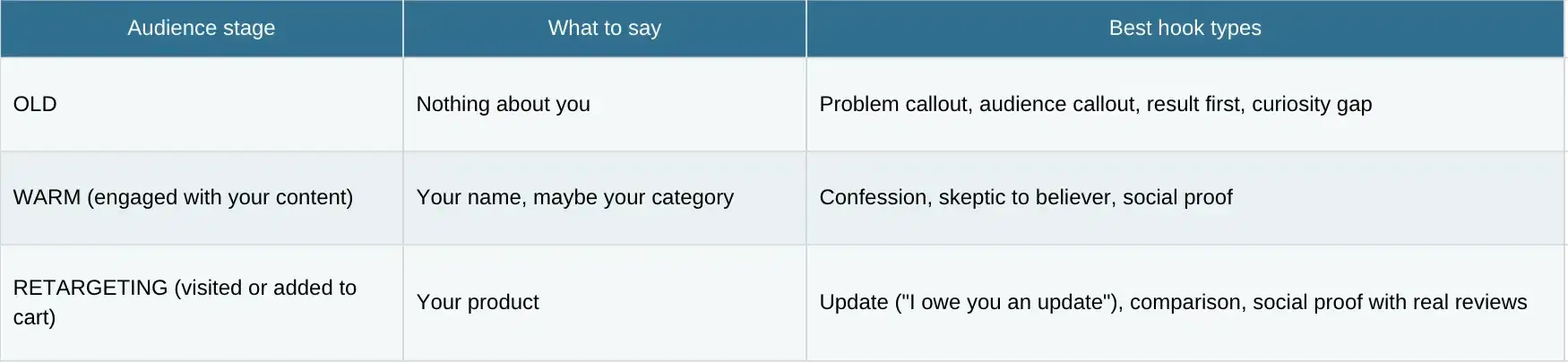
The same hook doesn't land the same way with a stranger and with someone who's already visited your site.
AudienceWhat they already knowHook types that tend to work
For cold audiences, 15 to 30 seconds is the usual range. Longer cuts can work for retargeting people who already need a little more convincing. We cover that in more detail in our Facebook UGC video ads guide.
How to Test UGC Ad Hooks
Most brands test whole videos. It's slower and teaches you less. The middle of a UGC ad (the problem, the product, the proof) often stays the same while the opening changes. So test the opening on its own.
Step 1: Lock the body. Pick one video. Same creator, same demo, same call to action.
Step 2: Cut 3 to 5 different openings. One per hook type, not five versions of the same idea. A confession, a problem callout, and a result-first opening will teach you far more than three variations of "I wasn't going to post this."
Step 3: Run them together. Same audience, same budget, same placements. Change only the first three seconds.
Step 4: Read hook rate first. The most common way to calculate it:
Hook rate = 3-second video plays ÷ impressions × 100
Then check how many people stay: a hold rate such as ThruPlays ÷ 3-second plays. Definitions vary between media buyers, so pick one and use it consistently.
For reference, Veel's UGC strategy framework uses 30%+ hook rate and 40%+ completion rate as working targets. Treat those as starting points, then build your own benchmarks from your account.
Step 5: Confirm with cost per result. A hook that stops thumbs but doesn't convert isn't a winner. Give each variant enough impressions before you call it, and don't judge on a handful of views.
Step 6: Keep the winner, retire the loser, test a new type. Then refresh. UGC fatigues faster than polished creative, so on active campaigns plan to rotate in new openings every one to two weeks.
Once you have 20+ clips and hook variants, finding the right one gets slow. Veel's Content Library stores them by campaign, and approved content can auto-post across Meta, TikTok, and YouTube. For more on tracking what drives revenue by creator, see our guide to UGC for social media.
How to Get Creators to Film Multiple Hooks
Here's a trick that cuts the cost of testing sharply: ask for the hooks in the brief.
Tell the creator to film the main video once, then record three different openings back to back using three hook types you name. Don't hand over scripts. Give them the idea ("a confession," "a problem callout," "a skeptic opener") and let their own voice fill it in. Authenticity comes from their phrasing, not yours.
A few brief details that save headaches:
- Name the hook types, not the exact words.
- Ask for the first frame to show the product or the problem.
- Request captions-friendly speech: short sentences, clear audio.
- Confirm usage rights for paid ads in writing before filming. If you plan to run the video from the creator's handle, set that up at the briefing stage too.
On Veel, you set the brief and AI matching surfaces creators by niche and budget, with first content typically landing in 24 to 48 hours. Start a creator campaign, check market rates first with the Creator Pricing tool, or request a campaign plan if you'd rather have help scoping it. If you're still working out where to find the right people, read the best ways to find UGC creators.
Already have influencer content sitting on a drive? You can turn influencer content into UGC ads and cut fresh hooks from the footage you already own.
Common UGC Ad Hook Mistakes
Opening with "Hey guys, so today..." The first sentence is a warm-up and the viewer is already gone. Start with the point.
Leading with the brand. A logo or brand name in frame one says "advertisement" before the first word. Let the creator earn the brand mention later.
A hook the video doesn't pay off. Curiosity-gap and result-first hooks only work if the next ten seconds deliver. Bait that bounces people wastes spend and teaches the algorithm your ad isn't worth showing.
Testing five versions of one idea. If all your hooks are confessions, you've run one test. Spread the types.
Ignoring sound-off. If the hook only works as audio, mute viewers see a person's mouth moving. Add text.
Over-polishing. Studio lighting, branded intros, and heavy transitions undo the authenticity you paid for. Raw beats produced. For examples of formats that hold up, see UGC ads examples for SMBs.
Forgetting the landing page. A hook that promises one thing and a page that shows another loses the sale after the click. We cover the handoff in the social-to-sale gap.
FAQs
What is a hook in a UGC ad?
A hook is the first one to three seconds of the video: the spoken line, on-screen text, and opening shot together. Its only job is to stop the scroll and give the viewer a reason to keep watching.
How long should a UGC ad hook be?
Keep it to about three seconds, or one short sentence. If the line takes longer than that to say, cut it down. The on-screen text version should be roughly seven words or fewer.
What is a good hook rate for Facebook video ads?
It depends on your industry, audience, and how you calculate it. Veel's UGC strategy guide uses 30%+ as a working target for hook rate. Start there, then build your own baseline from your account's past ads.
How many hooks should I test per ad?
Three to five is a sensible range. Fewer than three gives you too little to learn from, and more than five splits your budget across variants that each get too little spend to judge.
Do UGC ad hooks work the same on TikTok and Reels?
The principles carry over: stop the thumb, signal who it's for, open a loop. Pacing and tone differ a little by platform, with TikTok generally rewarding faster, more raw openings. Our guide to UGC for social media covers how to adapt content across platforms.
Can I use a customer's video as an ad?
Only with written usage rights, every time. Confirm music licensing too, since unlicensed audio can get an ad pulled.
Ready to Test Your First Hooks?
Brief creators, get videos in 24 to 48 hours, and pay on delivery. Ask each creator to film three openings and you'll have a hook test before you've spent a cent on production.
Not sure Veel is the right fit yet? See how it stacks up in our UGC platform comparison, or get a free read on your current social presence with the Social Media Audit.