
Jeevan PokharelJuly 21, 2026
Instagram Influencer Rates by Tier: A 2026 Pricing Guide for Brands
Ask five Instagram creators with 8,000 followers what they charge for a Reel, and you'll get five different numbers anywhere from $50 to $500. Ask a brand what they budgeted for their last campaign, and there's a good chance they either overpaid out of guesswork or underpaid and lost a good creator to someone who offered a fairer rate.
The problem isn't that Influencer Marketing pricing is random. It's that most public rate guides are too broad to actually plan a budget from. This guide breaks Instagram pricing down by tier, content format, and niche, with the hidden costs most brands forget to budget for and a practical framework for negotiating rates that work for both sides.
Treat every number below as a planning range, not a fixed price. Actual rates shift with engagement quality, niche demand, and the specific creator's experience.
TL;DR
- Nano influencers deliver the best cost-per-engagement on Instagram, even though they're the cheapest tier.
- Reels cost roughly 2–3x more than static posts: and usually earn that premium back through algorithmic reach.
- Niche is a bigger price driver than follower count. A finance or B2B micro creator can charge double what a general lifestyle account with the same audience size charges.
- Usage rights and exclusivity are where budgets quietly blow out expect 20–50% on top of the base rate for either.
- Follower count is a weak signal of value on its own. Engagement rate and niche fit tell you far more about what a creator is actually worth.
- The strongest negotiating lever isn't a discount it's volume, commission structures, or early product access.
What Actually Drives Instagram Influencer Pricing
Five factors set the price on any given piece of sponsored content. Understanding them is what separates a brand that negotiates well from one that just accepts whatever number a creator quotes.
Follower count and tier. This is the starting point most rate cards are built around, but it's also the crudest measure. A nano creator with 8,000 tightly engaged followers regularly outperforms a mid-tier account with 200,000 passive ones yet the mid tier account will quote a far higher rate simply because of tier.
Engagement rate. This is the number that actually matters. Not all engagement is equal, either saves and shares signal real purchase intent, while a feed full of likes from inactive followers doesn't. Nano creators post some of the highest engagement rates on the platform, often north of 2%, while many macro accounts sit under 1%.
Niche. Audiences in finance, B2B, and health are harder to reach and more valuable to advertisers, so creators in those spaces charge accordingly often double what a comparable lifestyle or fashion account would ask.
Content format. A 60-second Reel with scripting, filming, and editing simply takes more work than a single static photo, and pricing reflects that gap.
Usage rights and exclusivity. This is the line item brands most often forget until the invoice arrives. Wanting to run a creator's content as a paid ad, or asking them to sit out competitor deals for a stretch of time, both cost extra -and can meaningfully change the total price of a "simple" post.
Instagram Rates by Tier (2026 Benchmarks)
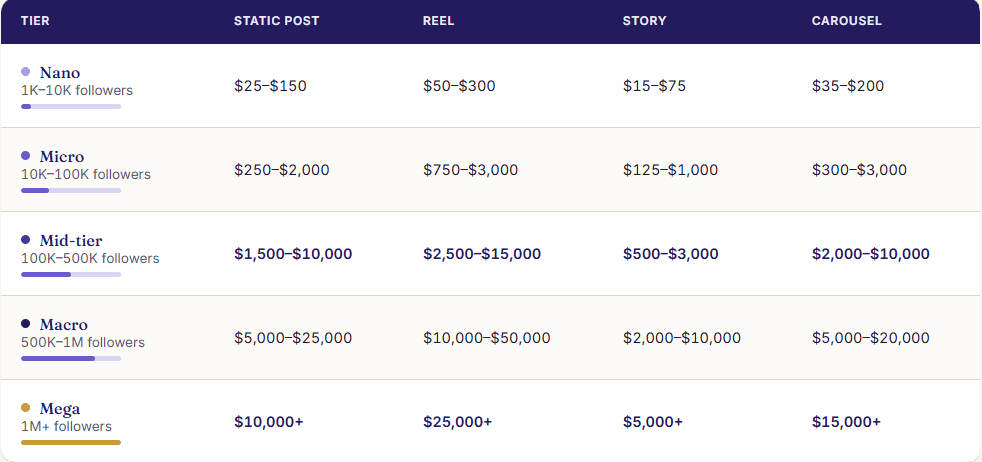
A few things worth understanding about this table:
The spread within each tier is wide by design. A nano creator with 2,000 followers and 1.5% engagement is a very different proposition from one with 9,000 followers and 5% engagement both fall in the "nano" bucket, but one is worth several times more.
The biggest jumps in price don't happen evenly across the ladder; they cluster at two points: moving from nano to micro, where creators start treating content as real income, and moving from mid tier to macro, where agents and management start taking a cut.
For most e-commerce and DTC brands, nano and micro creators offer the strongest return per dollar spent higher engagement, more authentic feeling content, and enough budget headroom to work with 10+ creators instead of gambling on one expensive placement.
What Nano and Micro Creators Actually Charge in Practice
Most nano creators charge $25–$150 for a static post and $50–$300 for a Reel and a meaningful share will work for the product alone if the brand fit is genuine, especially early in their creator journey. Stories are typically the cheapest deliverable, often priced per frame and bundled in sets of three to five.
Micro creators are where pricing starts to look more professional. Many will have a media kit and a standing rate card ready before you even ask. A useful gut check at this tier: divide the quoted rate by average engagements per post (not follower count) to get a rough cost-per-engagement. Under roughly $0.50 per engagement is solid value; under $0.25 is excellent.
This is exactly the kind of comparison a creator marketplace makes easier. On Veel, brands can browse vetted nano and micro creators across 121+ countries with engagement history visible upfront, rather than collecting rate cards one DM at a time.
Pricing by Content Format
Reels are the most expensive format on Instagram, and it's earned they get the strongest algorithmic push and the most organic reach, but also require real production effort. Expect roughly a 2–3x premium over a static post at any tier.
Carousels sit in the middle. They take more assets to produce (typically 5-10 slides) and tend to earn strong save rates, which is a meaningful purchase intent signal for product comparison or educational content.
Static posts are the baseline format still effective for product launches and aesthetic driven categories like beauty and food, even though they've lost some organic reach relative to video formats.
Stories are the cheapest deliverable, typically priced per frame. They're a strong add on to a post or Reel package rather than a standalone campaign, especially for creators whose Story audience is highly responsive (polls, replies, swipe throughs).
Pricing by Niche
Niche affects price more than most brands expect, because it reflects how hard an audience is to reach not how much effort the content takes.
Premium niches (roughly 2–3x baseline rates):
- Finance and investing high intent, high disposable income audiences
- B2B and SaaS small audiences, but each follower can represent a large deal size
- Health and wellness a regulated space where credentialed creators (trainers, nutritionists) command a trust premium
Mid range niches (roughly 1–1.5x baseline):
- Beauty and skincare, where specific expertise (dermatology, clean beauty) pushes pricing above general beauty content
- Fitness, where niche sub categories (postpartum, powerlifting, yoga) hold pricing power even in a saturated market
- Parenting, where strong engagement and purchase intent support above baseline rates
Competitive niches (baseline rates):
- General lifestyle and fashion, where a large creator supply keeps pricing competitive unless the creator has a distinct angle
- Food and beverage, where rates stay reasonable except for creators with recipe development or food styling skills
The practical takeaway: niche fit is a better budgeting signal than follower count. A 5,000-follower creator in a premium niche will often out convert a 200,000 follower lifestyle account for a fraction of the price.
Hidden Costs That Blow Up Influencer Budgets
The quoted rate is rarely the final number. Four costs consistently catch brands off guard:
Usage rights. Wanting to run a creator's Instagram content as a paid ad on Meta, TikTok, or your own site is a separate license, typically adding 20–50% to the base rate depending on duration and placement. Negotiate this upfront; retroactive licensing is harder to secure and usually costs more.
Exclusivity. Asking a creator not to work with competitors for a stretch of time costs money, since you're asking them to turn down other income. A short window adds modestly to the rate; anything approaching 90 days can roughly double it. Before requesting exclusivity, it's worth asking whether the campaign actually needs it.
Extra revision rounds. Most creators build one round of revisions into their quote. A vague brief tends to produce content that needs reworking and that reworking isn't free. Clear creative direction upfront is the cheapest way to avoid this cost entirely.
Rush fees. Compressing a two week timeline into 48 hours typically adds a meaningful surcharge, since it means reshuffling a creator's existing content calendar. Planning campaigns two to three weeks out avoids this altogether.
Add it up, and a $200 nano creator post with usage rights, some exclusivity, and a rushed timeline can land closer to $500. Budget for the full scope of what you actually need, not just the number on the rate card.
Why Nano and Micro Creators Win on Cost Per Engagement
Lower rates alone don't make smaller creators the better deal the math behind cost-per-engagement does.
Take a simplified comparison: a macro creator with 800,000 followers charging $10,000 for a Reel at 0.8% engagement delivers roughly 6,400 engagements about $1.56 per engagement. A micro creator with 40,000 followers charging $1,000 at 3% engagement delivers around 1,200 engagements closer to $0.83 per engagement, despite the far smaller audience.
Now spread that same $10,000 across ten micro creators instead of one macro placement. The total engagement volume comes out meaningfully higher, and you walk away with ten distinct pieces of content instead of one useful for testing which creative angle actually resonates.
There's a risk-management upside too. A single expensive placement that underperforms means the whole budget is gone. Spreading spend across 10-15 smaller creators means a handful of strong performers can carry the campaign even if a few placements fall flat.
How to Negotiate Instagram Rates Without Burning the Relationship
Most brands negotiate the wrong way they ask for a flat discount, get told no, and the conversation stalls. A better approach:
Start by asking for the rate card, not against it. This tells you what the creator believes they're worth and whether they've priced consistently before. Creators without a standing rate card are often more flexible, but you'll need to propose a fair structure yourself.
Negotiate scope, not just price.
- If usage rights are quoted at 90 days, ask about 30 days first -it's easy to extend later if the content performs.
- Question whether exclusivity is actually necessary for the campaign before agreeing to pay for it.
- Booking three pieces of content instead of one is a legitimate reason to ask for a lower per post rate; creators generally prefer guaranteed volume over one off gigs.
Offer something other than a lower number. A multi month partnership at a slightly reduced per-post rate gives the creator income stability and gives the brand compounding trust with their audience. A lower base fee plus a commission on sales can work out better for both sides than a flat rate. Early access to a new product costs almost nothing to offer but is a genuine incentive for a creator's own content calendar.
Know when to walk away. If a creator won't move on price, scope, or terms, and the rate doesn't line up with their engagement data, there are thousands of other creators at every tier particularly at the nano and micro level, where supply is large and quality keeps rising.
The best deals aren't "won" through hard bargaining -they're structured so both sides come out ahead. A creator who feels fairly paid makes better content; a brand that overpays resents the partnership before it even starts.
Finding the Right Creator at the Right Price
Comparing rate cards one DM at a time doesn't scale past a handful of creators. A marketplace like Veel puts vetted nano and micro creators from over 121 countries in one place, with engagement history and pricing visible upfront so budgeting and negotiating from an actual benchmark, rather than a guess, takes minutes instead of a week of back and forth.