
Jeevan PokharelNovember 6, 2026
UGC Brief Template: How to Write a Creator Brief That Gets Usable Videos
You send the brief on Monday. By Friday, a video lands: shot horizontally, no captions, the brand name mispronounced, and a claim your legal team will never approve. The creator didn’t do a bad job. They did what the brief said, which was almost nothing.
If you run a small store, that’s a lost week and a lost fee. Most “bad UGC” is a brief problem, and it’s fixable. This post gives you a UGC brief template you can copy, the nine sections that matter and why each one is there, a filled-in example, and a way to brief for hooks so your first UGC ad test doesn’t need a reshoot. It’s written for small business owners who need usable videos on the first try.
What Is a UGC Brief?
A UGC brief is a one- or two-page document that tells a creator what to make: the product, the goal, the audience, what to say and show, the technical specs, and the usage rights. Think of it as a spec, not a script. A good brief leaves room for the creator’s own voice.
Why small businesses need a brief more than anyone
Picture a candle shop with $300 to spend on creator videos. Two creators get a one-line message: “make something cute with our candle.” One video comes back with trending music that can’t be used in ads. The other mentions a “stress-curing” scent, which the shop can’t claim. Half the budget just disappeared.
Big brands can absorb that. You can’t. A one-page brief protects your budget, and it’s the cheapest edit you’ll ever make. If you’re collecting UGC for your store, our guide to UGC for ecommerce shows where those videos go once you have them.
What Goes in a UGC Brief: The 9 Sections
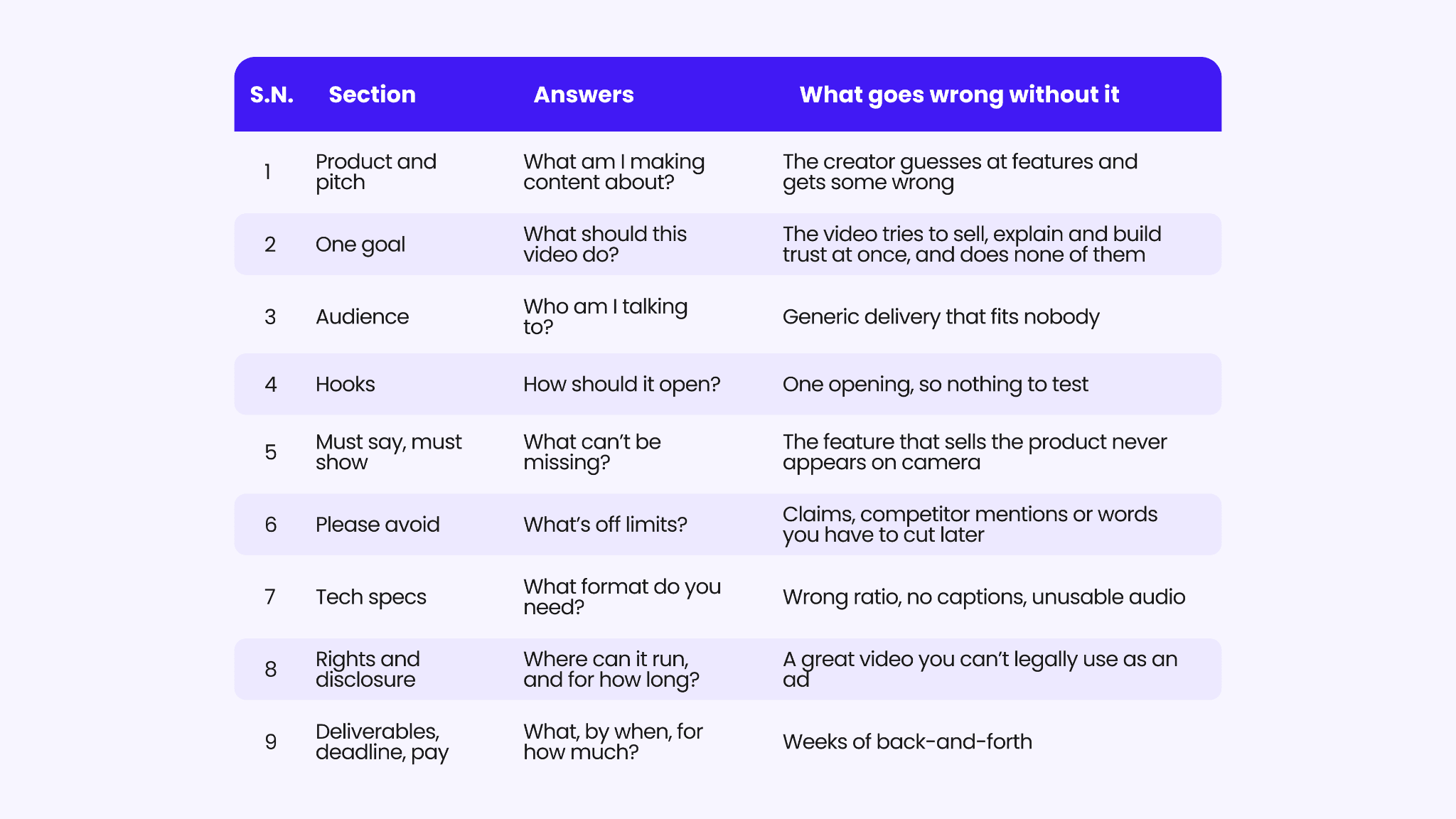
Every section below exists because leaving it out causes one specific, predictable problem.
1. The product
Tell the creator what it is in one line, who it’s for, and the one thing it does better than the alternatives. Add the product link so they can see it in context. Skip the brand history. A creator can’t film your founding story this week.
2. The goal (pick one and say it out loud)
A video built to get a click, show the product working, and earn trust in 20 seconds usually manages none of the three. Choose the job. “Get a first-time viewer to understand what this is and tap through” is a goal. “Raise awareness and drive sales” is two goals wearing one coat.
The goal also tells the creator where the video will live. A video for Facebook and Instagram ads is paced differently from a post on the creator’s own profile. If you’re running Meta ads, our guide to UGC video ads for Facebook covers what to put behind the brief.
3. The audience
Describe who they are and what they’re tired of. Then give the creator the audience’s own words for the problem, not yours. “I’m basically paying rent to a barista” is far more useful than “cost-conscious coffee consumers.”
4. Hooks: brief them by type, not by script
This is the section most briefs skip, and it’s the cheapest place to buy more tests. Ask the creator to film the body of the video once, then record three different openings back to back. Name the hook types and let them find the words.
A brief line might read: “Film three openings. A confession (‘I wasn’t going to post this, but…’), a problem callout, and a result-first shot. Each is one to three seconds, with the product or the problem in the first frame and about seven words of on-screen text.” The full menu of types lives in our post on 26 UGC ad hooks, so pick from there rather than inventing categories.
What you don’t want is a line-by-line script. A creator reading your copy sounds like someone reading your copy, and the whole reason you’re paying for UGC is that it doesn’t. If you need a starting structure, our UGC ad script templates show how to give direction without writing every word.
5. Must say and must show
List the few things the video has to cover. Keep “must say” to key points in the creator’s own words, and “must show” to the moments that prove the product works: the pour, the fit, the texture, the first use.
6. The “please avoid” list
It’s the shortest section and the one that saves the most edits. Claims you can’t substantiate, health or income promises, competitor names, words your legal team has banned. If your category has regulated claims, list them. Creators aren’t mind readers, and “we’ll just trim it in the edit” works until the claim is the whole video.
7. Technical specs
Tell them the format, length, captions, audio, and what to deliver. Vertical 9:16 at 1080 x 1920, 15 to 30 seconds, burned-in captions from the first second, clear voice with no licensed music, and the final video plus raw clips. Without this, you get horizontal video and a silent Friday afternoon.
8. Rights and disclosure (put them in the brief, not in a follow-up)
Creators price paid-ad usage differently from organic posting. If the brief says “organic post” and you later decide to run it as an ad, you’re renegotiating after the work is done. Or you can’t use the video at all.
So say it up front: which channels, paid or organic, for how long, and whether the ad will run from the creator’s handle (Meta calls these partnership ads) or yours. Our guide to UGC video content rights explains the terms to put in writing. Add music to the list. A trending sound that’s fine on a personal post can get a paid ad pulled, which is why we wrote about music copyright for creators and brands.
Disclosure belongs here too. In the US, the FTC expects creators to disclose material connections to the brands they work with, and other countries have their own rules. Tell the creator how you want it handled, and check the rules wherever you’ll advertise.
9. Deliverables, timeline, and pay
Spell out what you’re getting, the draft deadline, how many revision rounds are included, the fee, and when it’s paid. Creators decide faster, and better ones reply, when the price is visible. Not sure what to offer? Check market rates with Veel’s free Creator Pricing tool.
The UGC Brief Template You Can Copy
Fill this in, keep it to one page, and send it with the fee and the deadline. Cut any line you can’t fill with something specific.
UGC BRIEF: [Product name]
1. THE PRODUCT
What it is (one line):
Who it’s for:
The one thing it does better than the alternatives:
Product link:
2. THE GOAL
This video’s one job (pick one): sell / get a click / build trust / show how it works
Where it will run: Facebook and Instagram ads / TikTok / organic post / product page
3. THE AUDIENCE
Who they are and what they’re tired of:
How they describe the problem (their words, not ours):
4. HOOKS (film 3 openings, same video body)
Opening A: [hook type + idea]
Opening B: [hook type + idea]
Opening C: [hook type + idea]
Each opening: 1-3 seconds, product or problem in frame one, about 7 words of on-screen text.
5. MUST SAY / MUST SHOW
Must say (in your own words):
Must show on camera:
6. PLEASE AVOID
Claims we can’t make:
Words or topics that are off limits:
Competitor mentions:
7. TECH SPECS
Format: 9:16 vertical, 1080 x 1920
Length: 15-30 seconds
Captions: burned in from the first second
Audio: clear voice, no licensed music
Delivery: final video plus raw clips
8. RIGHTS AND DISCLOSURE
Usage: [organic only / paid ads] for [duration]
Run from the creator’s handle? [yes / no]
Disclosure: [how the partnership should be labeled]
9. DELIVERABLES AND TIMELINE
Deliverables:
Draft due:
Revisions included: 1 round
Payment: [amount], paid on [delivery / approval]Questions to:
A Filled-In UGC Brief Example
Here’s how a few of the trickier sections look for a made-up brand, Brightside Cold Brew Concentrate. The brand is fictional. The structure is the point.
2. THE GOAL
Get a first-time viewer to understand that this makes café-quality cold brew
at home in under a minute, and tap through. Running as a Facebook and
Instagram ad.
3. THE AUDIENCE
Office workers who spend $6 a day on iced coffee and know it.
They say “I’m basically paying rent to a barista.”
4. HOOKS
A (confession): “I stopped buying iced coffee and nobody warned me this easy.”
B (problem callout): receipt-pile shot, “This is what my coffee habit cost in March.”
C (result-first): pour of the finished drink in frame one, then “Okay, watch this.”
5. MUST SAY / MUST SHOW
Say: one splash of concentrate, cold water, ice. Done.
Show: the pour, the 1:3 ratio on the bottle, the first sip.
6. PLEASE AVOID
No “healthy” or “energy” claims. No mention of other coffee brands.
8. RIGHTS AND DISCLOSUREPaid ads on Meta for 90 days, run from the brand’s handle. Mark as a paid partnership.
Notice what’s missing: no script, no brand history, no paragraph about the founder. The creator gets the job, the person, the openings, and the guardrails.
How Long Should a UGC Brief Be?
One page. Two if you’re briefing several deliverables. Past that, creators skim, and skimmed briefs get skimmed results.
If you catch yourself pasting in the brand deck, stop. The creator needs what they can act on this week: what to film, how to open it, what to avoid, when it’s due. The origin story can wait for the kickoff message.
UGC Brief vs. Influencer Brief
They overlap, but they aren’t the same document. An influencer brief covers a post that lives on the influencer’s own channel, so it cares about posting dates, tags, links, and audience fit. A UGC brief covers the asset itself: the format, the hooks, and the rights to reuse it in your ads. Our breakdown of UGC creators vs. influencers explains where the lines fall, and our guide to influencer marketing for ecommerce covers the influencer side.
Already have influencer content sitting around? You can turn influencer content into UGC ads, but the usage rights need to allow it.
6 UGC Brief Mistakes to Avoid
Scripting every word. The video comes back stiff. Give key points and let the creator’s voice do the work.
Hiding the ad plan. Telling a creator it’s for organic posting and then running it as a paid ad is how relationships (and budgets) end.
No reference examples. Words like “authentic” and “casual” mean different things to different people. Two or three links to videos you like do more than a paragraph of adjectives. Our roundup of UGC video examples that feel authentic is an easy place to start.
Forgetting the first frame. Creators open with “Hey guys, so today…” unless you tell them otherwise. Put the first-frame instruction in the brief.
Briefing five creators by email. Five slightly different versions, three missing deadlines, and nobody sure which rights window is open. One shared brief in one place fixes most of it.
Leaving out the fee. If you’re not sure what to offer, use the Creator Pricing tool above or read what UGC creators earn.
Check Every Video Against the Brief
Before you approve a delivery, run it through five quick checks:
- Does the first frame show the product or the problem?
- Are the captions on from the first second?
- Is the audio clear, with no unlicensed music?
- Is every claim on the “please avoid” list absent?
- Does the file match the specs (9:16, length, resolution)?
If the answer to any of them is no, that’s your one included revision. If you’re running a larger program, the UGC video campaign management guide and our UGC strategy framework show how to keep briefs, rights, and results organized across many creators.
Once the videos are approved, put them to work. Our guide to video marketing for ecommerce shows where they belong on your site and in your ads.
Where to Send Your UGC Brief
A brief only works if it reaches the right creator. On Veel, you set the brief and AI-powered creator matching surfaces creators by niche and budget, with first content typically landing in 24 to 48 hours, and you pay on delivery. You can start a creator campaign, or request a campaign plan if you’d rather have help scoping it.
Stuck on what the hooks in your brief should say? The free Content Idea Generator maps the audiences and use cases your product could speak to. And if you’re still deciding where to find people, start with the best ways to find UGC creators.
UGC Brief FAQs
What should a UGC brief include?
A UGC brief should cover nine things: the product and pitch, one goal, the audience, three hook ideas, must-say and must-show points, things to avoid, technical specs, usage rights and disclosure, and the deliverables, deadline, and pay.
How long should a UGC brief be?
One page is ideal and two is the limit. If a creator can’t find the specs and the deadline within seconds, the brief is too long.
Should a UGC brief include a script?
Usually not. Give the creator the key points and the hook types, then let them say it their way. Scripts read as scripts, and viewers can tell.
Should a UGC brief include the fee?
Yes. Put the fee, the payment timing, and the usage rights in the brief or in the invitation that comes with it, so creators can decide before they film.
Who owns UGC content after the creator films it?
It depends on what you agree. Often the creator keeps ownership and you license the content for set uses and a set period. Write the channels and the duration into the brief, and get the agreement in writing.
What is the difference between a UGC brief and a UGC script?
A brief tells the creator what the video must achieve, show, and avoid. A script writes out the words. Brief for the first and let creators handle the second, so the video sounds like a person, not an ad.
Ready to Send Your First Brief?
Fill in the template, add the fee, and get it in front of creators who fit your product. Start your first campaign free.
Not sure Veel is the right fit yet? See how it compares in our UGC platform comparison, or get a free read on your current social presence with the Social Media Audit.
Comments
Want to join the discussion?
Comments come from our Discord community.