
Rakshya BasnetNovember 4, 2026
Influencer Marketing on a Small Budget: How to Run Campaigns That Actually Pay Off
You’ve seen the quotes. One post from a big-name influencer costs more than your entire monthly marketing budget. So you close the tab, go back to posting on your own page, and hope someone notices.
Here’s the good news: influencer marketing on a small budget works, as long as you spend it differently than the big brands do. For small business owners and growing ecommerce stores, the winning move isn’t chasing the biggest name. It’s finding the right creators, giving them a clear job, and tracking what comes back.
Creator marketing is getting more crowded at the top. According to IAB’s 2025 Creator Economy Ad Spend & Strategy Report, U.S. creator ad spend was projected to reach $37 billion in 2025, up 26% year over year. That doesn’t mean you have to fight for the priciest deals. This guide shows how to run influencer campaigns on a small budget and still get meaningful results.
What Is Influencer Marketing on a Small Budget?
Influencer marketing on a small budget means working with affordable creators, such as nano and micro-influencers, and using low-cost formats like product gifting, UGC, and affiliate commissions. Instead of paying one big fee up front, you spread a limited budget across several creators and invest more in what performs.
9 Ways to Run Influencer Campaigns on a Small Budget
1. Pick audience fit over follower count
The fastest way to waste a small budget is choosing creators by follower count alone. A creator with 500,000 followers looks impressive, but if their audience doesn’t care about your product, you paid for reach you can’t use.
Before you reach out, check:
- Audience demographics and location
- Content niche and interests
- Engagement quality, such as real comments and real questions
- Past brand collaborations
- Content quality and communication style
- How closely their followers match your customers
Say you run a small skincare brand. Three beauty creators who talk about skincare routines every week will likely do more for you than one lifestyle influencer with a bigger but scattered audience. The goal is to reach people who are already likely to care.
Not sure what creators charge? Check real rates by niche and country with Veel’s free Creator Pricing tool, or read our Instagram influencer rates guide.
2. Work with nano and micro-influencers
Smaller creators are often the best value for a tight budget. Nano-influencers typically have fewer than 10,000 followers, while micro-influencers usually fall between about 10,000 and 100,000. Definitions vary, so treat those as common guidelines.
Smaller creators can offer:
- Access to specific niche communities
- Closer relationships with their audience
- Recommendations that feel personal
- The option to work with several creators at once
- A steady stream of different content styles
EMARKETER, citing Later’s 2025 influencer benchmarks, reported that U.S. nano-influencers had an average impression rate of 34.1%, more than double that of other influencers in the comparison. Treat that as a hint, not a promise. Impression rate isn’t engagement rate, and it doesn’t guarantee campaign results.
Working with several niche creators also protects you. If one post flops, you haven’t bet the whole budget on it. Learn more about nano-influencers and which influencer tier converts best.
Let software do the searching. AI-powered creator matching can surface creators by niche, budget, and performance, so you aren’t scrolling profiles for hours.
3. Choose one clear campaign objective
A small-budget campaign gets inefficient when it tries to do everything at once. Pick a single goal:
- Brand awareness: introduce your product to new audiences
- UGC collection: get authentic videos and photos you can use in your own marketing
- Website traffic: send people to your store or product pages
- Sales: drive purchases through creator links, affiliate deals, or discount codes
Your goal decides who you hire, how you pay them, and what you measure. If you want product videos, you don’t need creators with big audiences. You need people who can clearly demonstrate your product. If you want sales, prioritize audience fit, trackable links, and conversion performance.
4. Try product gifting and UGC campaigns
Paid sponsorships aren’t the only way to work with creators.
Product gifting. You send products to selected creators in exchange for the chance to experience your brand. Be upfront about expectations. Gifting doesn’t guarantee a post, and you shouldn’t make payment or free product depend on a positive opinion. If you need specific deliverables, agree on pay and terms in advance, and ask creators to disclose the partnership.
UGC campaigns. Here you commission content from creators rather than paying for access to their audience. You might request:
- Product demos
- Unboxings
- Tutorials
- Testimonials based on real experience
- Problem-and-solution videos
- Lifestyle footage of the product in use
That content can feed your social channels, website, and ads, as long as the agreed usage rights cover those uses. For a small team, it’s a practical way to build a library of creative without paying for a studio shoot. You can run these through structured creator campaigns, and our guide on UGC video content rights explains what to put in writing.
5. Write a short, clear brief
Unclear expectations cost money. They lead to revisions, missed deadlines, and content you can’t use. A good brief covers:
- What the campaign is about
- Who the product is for
- What makes it worth buying
- The content you need
- Key product facts
- Deadlines
- Pay and deliverables
- Usage rights
- Approval steps
Here’s a quick example for a skincare brand: “Show how you use the serum in your evening routine. Mention that it’s fragrance-free. One 30-second video, draft due in ten days. We may reuse the video on our site and in ads for 12 months.”
Then stop. Don’t over-script it. Creators know their audiences, and content that sounds natural performs better than content that sounds like an ad.
6. Reuse every approved video
One of the best ways to stretch a small budget is to get more from each asset. A creator video doesn’t have to live on one account. With permission, you can repurpose it as:
- An Instagram Reel or TikTok
- A Facebook post
- A paid social ad
- A product page video
- A landing page element
- An email asset
A single skincare review could become a short social clip, a testimonial on your product page, and an ad that highlights one benefit. Negotiate usage rights, paid advertising permissions, editing rights, and licensing length before the campaign starts, not after. Keep approved clips organized in one content library so you can find them later. For more ideas, see our guides on UGC ad scripts and video marketing for ecommerce.
7. Add affiliate partnerships
Instead of paying only a fixed fee, you can offer creators a commission on sales they drive through a unique link or discount code. That ties pay to results.
Here’s how it works:
- A creator gets a unique tracking link or code.
- Their audience visits your store.
- Customers buy.
- The creator earns the agreed commission.
It isn’t risk-free. You still need to account for product costs, commission rates, tracking accuracy, and the chance that a creator drives no sales at all. A hybrid can work well: a small flat fee plus a commission. Veel’s affiliate marketing tools track sales by creator, and our post on influencer marketing vs. affiliate marketing explains when to use each.
8. Track results and reinvest in what works
When money is tight, measurement matters even more. Track:
- Reach: how many people your campaign reached
- Engagement rate: how audiences interacted
- Video views: how much exposure the content got
- Link clicks: how much traffic creators sent
- Conversions: how many tracked actions became purchases
- Cost per asset: what each usable piece of content cost
- Cost per acquisition: what it cost to win one customer
Use unique links, discount codes, and affiliate reports to connect creator activity to store results. And don’t judge every campaign by the same yardstick. A UGC campaign built to produce creative should be judged on cost per asset and quality, while a sales campaign should be judged on conversions and cost per acquisition. Once you see what works, put more money behind those creators and formats.
9. Keep management simple
A small campaign can run on spreadsheets, emails, and DMs. Add more creators and it gets messy fast. You have to track applications, briefs, deliverables, approvals, content rights, payments, and performance. That’s time you’d rather spend selling.
A single platform can take over the admin. See how in the Veel section below.
What a $600 Influencer Budget Could Look Like
Here’s an illustrative split for a small skincare brand. Adjust the numbers for your product margin and market.
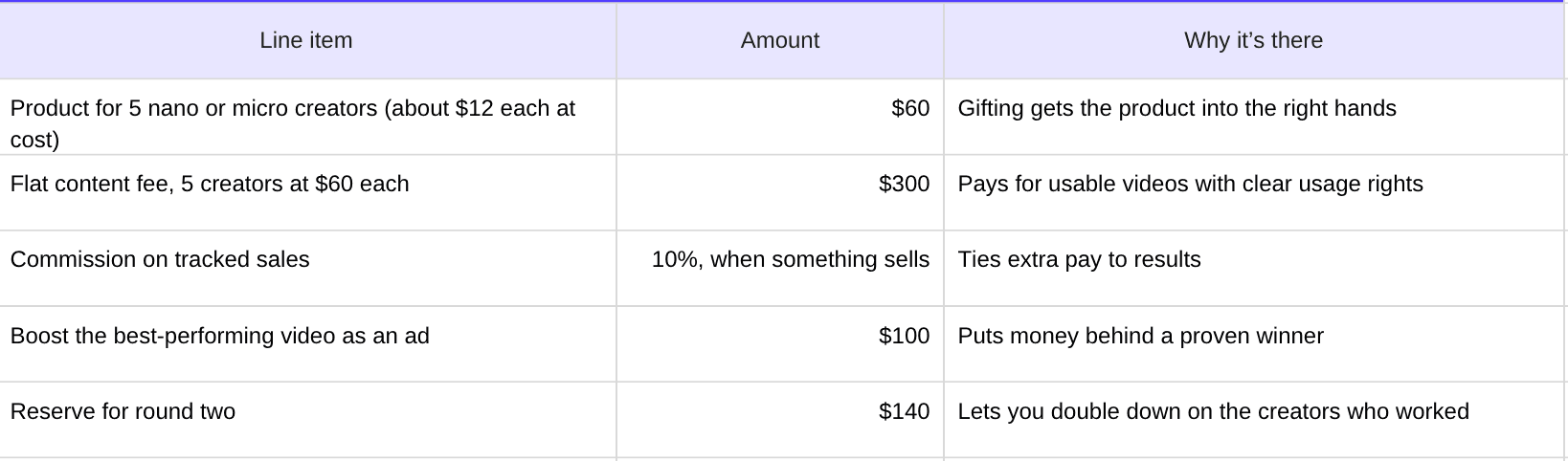
The fixed costs add up to $600, and the commission only gets paid when the sale happens. Notice what’s missing: no single big bet. For more low-cost tactics, see how to run a creator campaign for under $50.
4 Mistakes That Waste a Small Influencer Budget
Spending everything on one creator. One post can underperform for reasons you can’t control. Spread the risk.
Skipping the brief. Vague asks produce vague content and costly revisions.
Forgetting usage rights. If you can’t reuse the video in ads or on your site, you paid for a single post.
Treating every campaign as a one-off. The creators who worked once are your cheapest bet next time. Here’s how to build long-term influencer partnerships.
How Veel Helps Small Businesses Run Influencer Campaigns on a Budget
Veel brings creator discovery, campaigns, UGC, payouts, and tracking into one platform built for ecommerce and DTC brands, so a small team doesn’t need five tools and a spreadsheet to run creator marketing.
Find creators faster
AI-powered matching helps you discover creators by niche, budget, and performance, which saves hours of manual searching.
Launch and manage campaigns in one place
You can launch UGC and influencer campaigns, manage creator submissions, set content rights, handle payouts, and watch performance from one dashboard.
Start without a big commitment
Veel’s free tools and free account let you start before you spend. You can see pricing here, and your first campaign starts free, so a small budget goes to creators instead of software.
Frequently Asked Questions
Is there a minimum budget for influencer marketing?
There’s no official minimum. With gifting, UGC, and commission-based deals, you can start small and scale once you see results.
Should a small budget go to one creator or several?
Several is usually safer. Spreading a limited budget across a handful of nano and micro creators gives you more content, more data, and less risk than one expensive partnership.
Is product gifting enough?
Sometimes, but gifting doesn’t guarantee a post or a positive review. If you need specific content, agree on deliverables and compensation upfront.
How do I track sales from creators?
Give each creator a unique tracking link or discount code, then compare the orders each one drives against what you spent on them.
How many creators should I start with?
Five is a good test size. It’s enough to compare results, small enough to manage by hand, and affordable on a tight budget.
Start With One Goal and Five Creators
You don’t need a bigger budget. You need a tighter plan. Pick one objective, choose five creators whose audiences match your customers, send each a short brief, and give each a tracking link. Review the results after a few weeks, keep the winners, and put the reserve behind them.
When you’re ready for a hand, request a creator campaign plan and see how Veel can help you find the right creators and manage everything from one place. If you want the wider playbook first, read our guide to influencer marketing for ecommerce.
Comments
Want to join the discussion?
Comments come from our Discord community.